



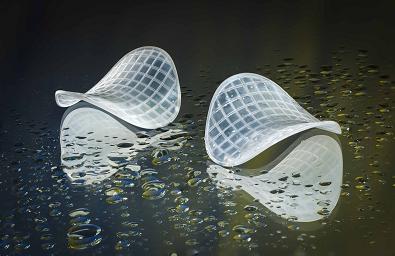
A New Dimension in MBBR Technology
06/10/2014 Veolia Water Technologies (formerly ELGA)
Veolia Water Technologies has launched a new generation of biofilm carriers for moving bed biofilm reactors: AnoxKaldnes Z-MBBR. The new carrier is the result of two decades of development work.Christian Rosen, one of Veolia's Process Specialists explains: "Many biological processes use several different types of bacteria all needing different environments. Our challenge was to produce a biofilm carrier that could provide those different micro-environments so as to encourage the growth of selected bacteria. We can do that by precise control of the biofilm thickness which eliminates variations in performance and removes the limitations associated with clogging of the carriers."
Unlike conventional MBBR carriers, Z-MBBR has a unique three-dimensional contoured structure that allows the creation of a self-controlled, pre-determined biofilm thickness on the carrier. This gives a controlled redox gradient and maximises mass transfer. Veolia's Z carriers are customised to give biofilm thicknesses ranging from 200µm for fully aerobic processes like nitrification to 500µm for applications like Veolia's ANITAMox ammonox denitrification system, which require aerobic, anoxic and anaerobic conditions on the same carrier.
Veolia's first Z-MBBR full-scale plant is currently under construction and will be fully operational by the end of 2014.
Visit the 8th European Waste Water Management Conference & Exhibition, Manchester (7th & 8th October 2014) to see a Z-MBBR demonstration or click here veoliawatertechnologies.com/mbbr/en/?uid=37422 for further information on Z-MBBR and other biological processes from Veolia.
For more information, please contact:
Veolia Water Technologies
Aqua House
2620 King's Court
Birmingham Business Park
B37 7YE
United Kingdom
Tel: +44 203 56 77 400
Web: www.veoliawaterst.co.uk
 Print this article
Share article:
Process and Control Today are not responsible for the content of submitted or externally produced articles and images. Click here to email us about any errors or omissions contained within this article.