



Contactless Encoders from Turck Banner
11/06/2013 Turck Banner Ltd
Could this be the death of the rotary encoder as we know it?It's not often that we see a revolution in the world of industrial sensors. The introduction of the Inductive Proximity switch as an alternative to the mechanical limit switch was one such moment.
Eliminating the mechanical parts dramatically increased reliability, whilst maintaining the form and function required of the limit switch, however the mechanical limit switch lives on, because in some applications its inherent weaknesses are never seen.
Factor 1 Inductive sensors, sensing all metals at the same distance, were another important moment in the history of industrial sensors. Turck had the revolutionary idea of replacing the wound coil and ferrite core at the heart of every inductive sensor with multiple coils printed on circuit boards. Although this once again eliminated a number of shortcomings of a traditional sensor the outdated inductive proximity switch lives on.
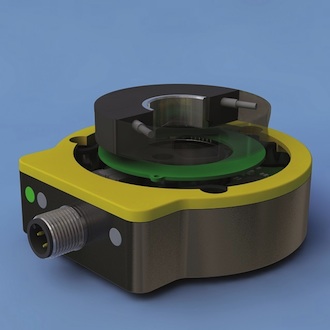
Turck have now unveiled their latest Quantum Leap in sensing technology. They have thrown out almost every part of a traditional rotary encoder and replaced it with state-of-the-art, fully encapsulated electronics. Most importantly there are no moving parts inside the encoder.
There is no contact between the passive positioning element fixed to the rotating machine shaft and the encoder. No bearings to wear. No possibility of dust or moisture penetrating the electronics. No problems with vibration or magnetic fields. In fact the mean time to failure is calculated at 138 years.
In eliminating the moving parts within the encoder, Turck have also eliminated one of the major problems for the encoder stockist. A traditional encoder has glass or plastic disk printed with a pattern of transparent and opaque areas. Every variant of encoder resolution, output type etc. requires a different disk. Manufacturers have warehouses full of these different disks, yet relatively few fully assembled and finished products, simply because the economics don't allow it. The majority of orders have to be built thereby extending delivery times. The new encoder has no disk, and the majority of parameters are all programmable, resulting in very low requirements for stock or spares.
A single model can replace thousands of different encoder types and standard mounting arrangements accommodate retro fitting with ease.
There is now no need to compromise between resolution and rugged design, the Turck RI-QR24 utilises a 32 bit microprocessor, is sealed to IP69K and has over 18 bit resolution.
In a conversation with Kelvin Lewis, Managing Director of Industrial Encoders Direct in Wrexham, Kelvin confirmed that the biggest problem they encounter with encoders is unreliability caused by vibration, shock and fluid ingress. "We get encoders sent to us for repair after as little as 2 years but some can last 30 years. It depends upon the environment they are in and how much work they have to do" A typical repair can cost anywhere from £60 to £300 depending on the encoder. Kelvin particularly liked the depth of the housing, which is considerably shorter than other encoders, and confirmed that the price was competitive with traditional encoders.
The Turck RI-QR24 is currently available for use with shaft diameters of 6 to 20mm as standard.
Output types for IO-Link, Modbus RTU, 4-€¦20mA, 0-€¦10V, SSi, RS485, and Gray coded.
20,000rpm speed,
18 bit resolution
25 bit Gray coded
Single or multiturn
Temperature drift less than +- 0.003%/K
e1 compliant for use on mobile machines
So what's the secret behind the encoder? Turck have developed an inductive resonance coupling circuit utilising emitter and receiver coils manufactured as printed circuit boards with exceptional precision. The coils and the positioning element form an inductively coupled circuit capable of precisely sensing the rotational position of the positioning element whilst ignoring lateral movement or a distance change. The positioning element is fixed to the rotating shaft and the sensor is mounted next to it with a small gap using standard encoding mounting points. The 32bit microprocessor evaluates the received signals and generates the output in whatever format has been configured.
Could this be the death of the rotary encoder as we know it? The market will decide.
For further information, please contact:
Turck Banner Ltd
Blenheim House
Blenheim Court
Wickford
Essex
SS118YT
Tel: 01268 578888
Email: encoders@turckbanner.com
Web: www.turckbanner.co.uk
 Print this article
Share article:

Process and Control Today are not responsible for the content of submitted or externally produced articles and images. Click here to email us about any errors or omissions contained within this article.