



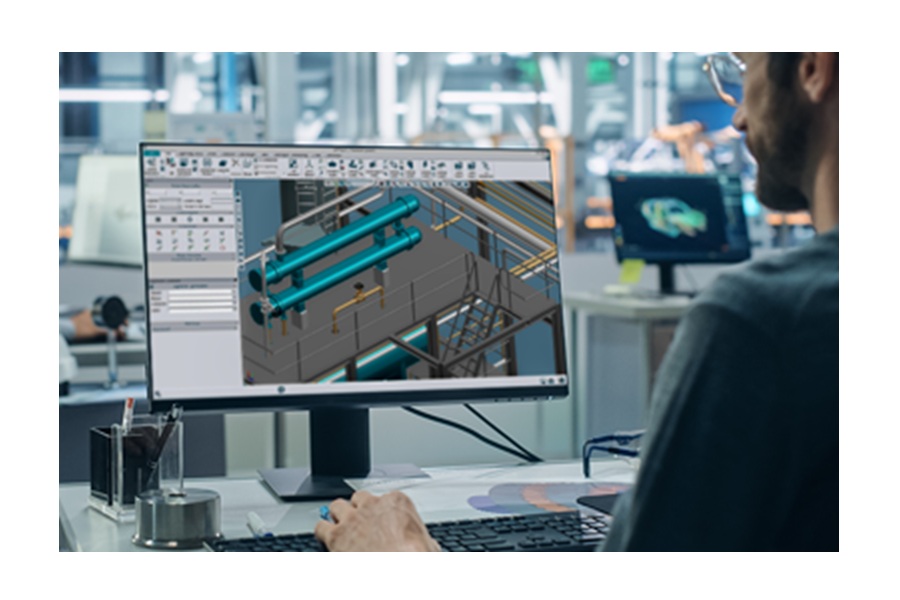
Designing large plants without hitting performance limits
05/10/2026 CAD Schroer UK Ltd
Growing project sizes and complex plants are challenging 3D design. Increasing data volumes are becoming the limiting factor.
When designing large industrial plants, conventional 3D CAD solutions often reach their limits. Extensive 3D models lead to long loading times, hinder navigation and reduce the efficiency of complex planning projects.
When software becomes the bottleneck
A modern industrial plant today comprises thousands to hundreds of thousands of components. Machinery, piping, fittings, steelwork and other plant elements are brought together in a single 3D model. As project size grows, the volume of data increases continuously, presenting new challenges for plant design. Conventional planning tools often reach their limits here. Assemblies and models load more slowly, and editing becomes noticeably sluggish. Projects are therefore often split into several sub-models, or objects are shown in simplified form. This makes the overall picture harder to grasp, lengthens coordination processes and increases the risk of relationships only being recognised at a late stage. The challenge, therefore, lies not in the size of the plant itself, but in managing and displaying growing volumes of data efficiently on an ongoing basis.
New demands on plant design
As modern industrial plants grow in size, the requirements placed on design software are also changing. Today, what matters most is no longer the range of functions alone, but the ability to display even very large models smoothly and edit them efficiently. Modern software architectures take a different approach here. They manage plant data independently of its graphical representation and display objects at different levels of detail depending on the task at hand. This means the full level of detail of a model does not have to be calculated at all times. Navigation, screen rendering and editing remain consistently fast even for large-scale projects. At the same time, the entire plant can be designed within a single continuous model, which simplifies coordination and makes planning processes more efficient.
Efficiency without size limitations
Modern software architectures create the conditions needed for even large plant models to be edited continuously and efficiently. They ensure that entire plants remain editable within a single model, and that working speed is maintained even as complexity increases. One example of this approach is the plant design software M4 PLANT. By combining a database-driven architecture with performance-oriented 3D visualisation, even extensive industrial plants can be edited within a single model. Planners retain an overview of the entire project and can assess changes immediately in context. The larger and more complex plants become, the more important it is for software not to become the limiting factor. This is how designing large plants with M4 PLANT remains efficient and smooth, even as complexity increases.
 Print this article
For more information, please contact:
CAD Schroer UK Ltd
39 Newnham Road
Cambridge
CB3 9EY
Tel: +44 1223 460 408
Email: info@cad-schroer.com
Web: https://www.cad-schroer.com
Process and Control Today are not responsible for the content of submitted or externally produced articles and images. Click here to email us about any errors or omissions contained within this article.