



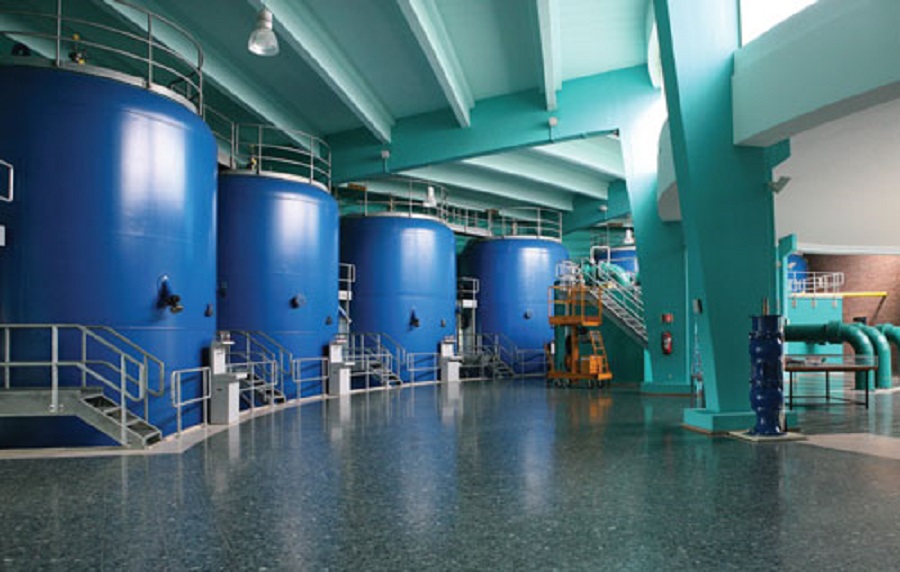
Düsseldorf’s Water Authority Stratus® ftServer® keeps Düsseldorf’s water supply running
24/11/2020 Stratus Technologies Systems Ltd
Ensuring sufficient high quality drinking water to meet the requirement of consumers requires absolute availability of a complex plant infrastructure at all times. When Düsseldorf Water Authority decided to review its infrastructure it considered hosting its control room servers on either cluster systems or fault-tolerant servers.
Business Objectives
Düsseldorf’s Water Authority provides water to over 600,000 residents. It operates from sites in Flehe, Am Staad and Holthausen. Each site contains extensive technical plant operations, all of which needs to be up and running at all times.
With wells, treatment plants, elevated tanks and pressure boosts and reducers in each location, the plant had been operated by programmable logic controllers since the 1990s. The system was controlled through a network of measuring devices with around 40,000 data points. If, for example, there was a leak in the distribution network, these devices could quickly locate it through any deviation from the required pressure readings. The information from the measuring and control devices from all three plants was then collated in the respective control rooms and the data archived. It was imperative, for legal, health and safety reasons, that this data was securely stored—and remained safely stored and permanently updated during any technology migration projects.
The control rooms at each location had an IT-assisted SCADA (Supervisory Control and Data Acquisition) control system. These systems collected information and put it into graphical form, so that service personnel could make quick adjustments to the waterworks. However, the fully automated control system meant that service personnel usually only had to monitor the process rather than make manual adjustments. The water authority did not want this to change.
The over-riding need was to find a hosting solution that could guarantee absolute availability of the system at all times, with absolutely no interruption to service or data collection whatsoever.
The control rooms at each location had an IT-assisted SCADA (Supervisory Control and Data Acquisition) control system. These systems collected information and put it into graphical form, so that service personnel could make quick adjustments to the waterworks. However, the fully automated control system meant that service personnel usually only had to monitor the process rather than make manual adjustments. The water authority did not want this to change.
The over-riding need was to find a hosting solution that could guarantee absolute availability of the system at all times, with absolutely no interruption to service or data collection whatsoever.
Doing so in a way that enabled Düsseldorf Water Authority to keep its existing infrastructure in place, without the need to train or bring in IT expertise was also important.
Business Solution
After much consideration, Düsseldorf’s Water Authority decided to replace two database servers and the central domain controller with Stratus ftServers. These servers have redundant hardware in one physical machine. Each component is doubled—CPU, RAM, IO units and the hard disk—and each of these operate totally in sync. So, should one component fail, its partner component continues to operate and an automatic message is sent to Stratus, ensuring a replacement component is dispatched immediately. There is no system down time, no loss of data and no need to restart the machine.
Furthermore, the failed part, which Stratus automatically sends, can be replaced while the machine continues to run and synchronises itself automatically with the system. The failure does not require any action by the administrator. There is no need for training or internal expertise.
“We evaluated a cluster system too, but not for long. Cluster systems are complicated to install and have a higher administration cost,” advises Heiko Jepp, team leader in the water mechanics department at Düsseldorf Water Authority.
“It soon became obvious that it wouldn’t have been an acceptable solution for us. The fault-tolerant servers are different in that no adjustments to the existing software are necessary; the redundant components operate as a single system, while, as a rule, applications in a cluster system need adapting,” he adds. Düsseldorf Water Authority has also been able to continue to use its Wonderware data-processing software without any changes.
“The fact that we still only need one licence to use it on our new servers, unlike a cluster, is a positive side effect of high availability,” explains Jepp.
“This offset the higher acquisition cost of a fault-tolerant system, so both options were identical from a cost point of view. The higher availability and the easy administration were crucial in our decision in favour of Stratus ftServer,” he concludes.
Business Impact
Stratus ftServers have been installed in two of Düsseldorf’s waterworks sites. The databases that record processing data operate on this system, receiving and saving data from the service area. A third server was installed in the central domain controller. The SCADA applications themselves continue to run on non-redundant Windows clients, so the wider IT infrastructure remains intact with no downtime or extra costs incurred.

The three new servers have proven themselves since the start of their operation in autumn 2011, with no downtime occurring at all. That though is not the only positive impact of hosting on Stratus ftServer, as Jepp points out:
“It’s a good feeling to know that you don’t need to worry any more about the storage of your data. We have been really well set up by its availability.”
 Print this article
For more information, please contact:
Stratus Technologies Systems Ltd
Waterman's House
Waterman's Court
Kingsbury Crescent
Staines
Middlesex
TW18 3BA
UK
Tel: +44 (0)1784 415220
Email: catherine.roberts@stratus.com
Web: https://www.stratus.com
Share article:

Process and Control Today are not responsible for the content of submitted or externally produced articles and images. Click here to email us about any errors or omissions contained within this article.