



FLIR THERMAL IMAGING HELPS CUT PUBLIC SPENDING
30/08/2011 FLIR Systems UK (*Teledyne FLIR)
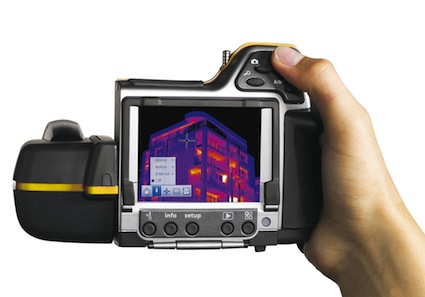
With public sector spending cuts very much in the spotlight local authorities are assessing every aspect of their work in order to ensure best value. For Leicester City Council one of the many measures it has taken is to bring the thermographic inspection of its building structures in-house to eliminate the cost of using specialist consultants.To conduct these inspections and assure public safety Leicester City Council has recently invested in two, FLIR B425 infrared cameras. Although checking the status of lath and plaster ceilings was the camera's initial role, the Council's buildings surveyors are now seeing its considerable potential for a much wider range of inspection, detection and energy management tasks.
Lath and plaster ceilings generally stand the test of time but they can be subject to sudden and unforeseen collapse. The main cause is either the corrosion of nails securing the laths or separation of the plaster material from the laths. The latter failure is usually due to physical damage cause by other building works (work carried out directly above the ceiling or within the floor void), or roof and under floor water leaks. The initial separation between surfaces is very small but it progresses rapidly, as the unsupported weight increases, until all or part of the ceiling collapses.
To prevent such an incident occurring in buildings in its care with this type of ceiling, Leicester City Council put in place a regular inspection programme several years ago. Initially this was a complex task. Surveys required the closure of the building to the public or its tenants and the removal of all furniture to accommodate scaffolding, powered hoists or hydraulic lifts. This equipment then allowed the structure to be physically inspected. However, not only was this logistically difficult but also exceptionally time consuming.
The introduction of thermal imaging saw the end to this disruptive, time-consuming and costly process. For seven years Leicester City Council employed external consultants to provide an infrared inspection service but now, armed with its own FLIR infrared cameras, it is making even greater cost savings by bringing this work in-house.
"Currently we have around one hundred properties identified with lath and plaster ceilings," explained building surveyor Mory Sharif. "Thermal imaging is the only non-destructive assessment tool that can perform this work without causing major disruption to the building users." Indeed it can easily be used even when the building is fully occupied.
Key factors in the Council's decision in favour of FLIR B-Series cameras were resolution, thermal sensitivity, lens choice, video output and the FLIR BuildIR building analysis software that, amongst other things, provides energy loss calculation. By using a thermal camera with a sensitivity rating of 50mK the air gaps in the lath and plaster ceilings can be easily identified by the inspector working at ground level as it provides an accurate and defined image over a distance. The level and span feature optimises the image quality displayed enabling the very small temperature differentials involved in the ceiling survey to be measured.
In addition to providing fine-limit measurement the FLIR B-Series also incorporates a range of additional features that enable professional building inspectors to do their job quicker, more easily and more efficiently. These include an insulation alarm that shows the insulation performance of a building structure and a humidity alarm that alerts the user to areas where there is risk of condensation.
A further benefit is the FLIR Panorama smart imaging stitching feature. An on-screen grid allows images to be dragged, dropped and automatically overlaid into a composite image. What makes this so clever however is that every pixel on the image is transferred with its own radiometric data. This is a unique ability for FLIR cameras. So, regardless of the eventual image size, accurate temperature measurement is assured and the enlarged image retains its JPEG format.
Panorama enables Leicester City Council surveyors to see the whole elevation of a building as a single, composite shot and is proving useful for identifying sources of heat loss when they will be performing energy performance surveys.
Mory Sharif continues: "We are very enthusiastic about this technology as we are keen to adopt new techniques that are more effective and efficient, enabling us to cut down time spent on site." And, the department certainly has ambitious plans to extend the use of its FLIR B425 infrared cameras.
Identifying mould growth areas, leaks and water ingress, the integrity of insulation, air tightness and overall energy performance of buildings is the priority. So too is flat roof and underground or under floor pipework inspection. Other applications are also being explored such as electro-mechanical predictive maintenance.
As Leicester City Council is discovering, the scope of this technology is extensive. Every new application that is added to the infrared list ensures quicker payback on its FLIR investment and even more operational cost savings.
For further information, please contact:
FLIR Systems Ltd
2 Kings Hill Avenue
Kings Hill
West Malling
Kent
ME19 4AQ
Tel: +44 (0)1732 220011
Fax: +44 (0)1732 843707
Email: sales@flir.uk.com
Web: www.flir.com
 Print this article
Share article:

Process and Control Today are not responsible for the content of submitted or externally produced articles and images. Click here to email us about any errors or omissions contained within this article.