




Greg Horsley sits down with Karl “Charly” Achter from Fluke Reliability to talk about condition monitoring
19/10/2022 Fluke Reliability Solutions

1. How do maintenance and reliability (M&R) teams get started with condition monitoring?
The first step to get started with condition monitoring is to review what’s happening with your equipment and your maintenance operations today. Start by identifying where you’re losing money, where you can save money, and make a plan to address your internal problems. Ask yourself these questions:
- What are my most critical machines?
- Where am I losing the most money and why?
- What are the biggest problems I’m facing? /
The second thing you need to consider is what your staff is trained to do and what they are capable of doing. Third, you’ll need to identify your Key Performance Indicators (KPIs) that will determine whether your condition monitoring program is successful.
2. How can M&R teams ensure they are selecting the right sensors for asset reliability?
The type of sensor that you need will depend on the complexity of the asset. For example, if you’re measuring something complex like a gearbox, you’ll need to consider whether a wireless sensor streams data often enough and with high enough quality to identify problems when they occur.
You’ll also need to consider whether you can get the measurement early enough so that you can react quickly and repair the machine before it breaks down. For situations like this, a wired system that samples continuously may be more suitable to ensure you never miss a notable event.
When selecting condition monitoring sensors, it’s also important to consider what your losses would be if your machine fails. In general, you should invest between 5% to 10% of the machine costs into your condition monitoring program.
3. What should M&R teams be looking for in an online condition monitoring system?
The right tool for the job depends on the complexity and criticality of your machines. You’ll need to classify your equipment and determine which machines you plan to monitor, while taking into consideration the complexity of the tasks the machine is handling; whether the machine handles variable loads, speeds, or conditions; how quickly failures can occur; and the risks and costs associated with total failure. Fluke Reliability offers worldwide services, as well as remote condition monitoring services that include expert consultation on the best fit for your program.
4. How does Fluke Reliability support customers to set up a Condition-Based Maintenance (CBM) program?
Fluke Reliability offers complete end-to-end condition monitoring solutions — from computerized maintenance management systems (CMMS) to measurement devices to services and support throughout the life of your program. We help you get off the ground by offering expert advice on the best opportunities to pilot your condition monitoring program and the best solutions to fit your company’s goals and priorities.
We also perform asset criticality assessment services, advising on what kind of monitoring tools and services should be used to provide the best outcomes for your company. Depending on your internal capabilities, you might decide to outsource the analysis for specific, very complex machinery.
5. What are the main benefits of a CBM program? Are you able to share examples from current customers?
With condition-based maintenance programs, you want to achieve three things. The first one, of course, is keeping people safe. A machine that experiences a total failure is a hazard you want to avoid whenever possible.
The second objective is managing the cost of machinery and spare parts. For example, if you can detect bearing failure in a pump early, you can stop the machine and repair it in a few hours. But if the failure goes undetected for too long, you may destroy your pump and require a new machine. That’s not only expensive, but it also takes up valuable time to complete the purchase and installation.
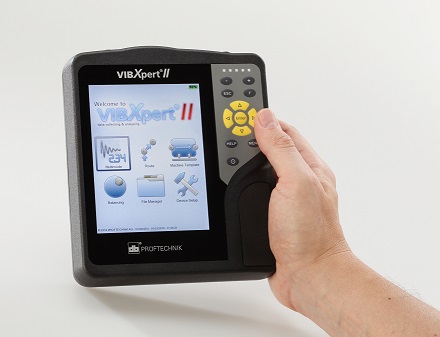 The third objective is maximizing machine uptime (and, on the flip side, avoiding costly unplanned downtime). I visited a customer in Munich who produced foil with extruders, and they bought a VIBXPERT II (pictured), a mobile power package for fast and reliable recording and analysis of machine condition data, because it was very important for them that the machinery did not stop. By starting a condition monitoring program, they were able to keep their machines running smoothly and avoid unexpected costs because they were able to identify bearing problems early on.
6. Fluke Reliability works with customers across a range of industries. Is there a need to modify a CBM program depending on the industry?
Yes. You need to dive into the program and define how to best monitor your specific machinery. There are many possibilities, and it depends on the criticality and complexity of your machinery. If you have a lot of simple pumps, then you may prefer a simple and cost-effective handheld measurement tool.
If you have more complex machinery with variable loads, variable speeds, or variable conditions — like a paper mill that uses different materials – these factors all influence how the machine responds. So, you must consider the right technique and timing necessary to correctly measure your specific machinery.
7. Over the last few decades, we’ve seen new technologies change condition monitoring, such as ultrasound technology. Which technologies do you expect to have an impact on CBM in the future?
Ultrasound technology is actually an extension of standard vibration sensors with a higher range. Prosonic sensors can tune into an even higher range, allowing you to detect bearing failures very early on, giving you plenty of time to repair or replace them before it leads to equipment damage. There are also new technologies in motion amplification, which help you find problems in your machinery by identifying resonance points.
I think one of the next steps is that mobile devices and sensors will become smaller and handier. Micro-electromechanical systems (MEMS) will have a big impact as well. And with A/D converters and 24-bit A/D converters, your sensors will collect a wider range of data faster, and you’ll have more space to store that data on the cloud. You’ll collect more data — much more data than you really need — but you’ll be able to use that data for evaluations and edge-performance analyses. From there, you’ll be able to learn much more about your machinery than every before.
8. Will integrating a CBM program and its associated products help with a customer's journey towards digitalization?
No matter where a company is in their digitalization journey, a CBM program is becoming a must for all plants. CBM programs can be piloted on key assets to quickly make a measurable impact on your KPIs — from maximizing uptime to saving costs to streamlining your maintenance operations. From there, a CBM program can be scaled to meet the needs of any plant, no matter how large, remote, or distributed their facilities.
9. Will a CBM program help in achieving carbon neutrality on the transition to net zero within the business?
Yes, of course! CBM programs help manufacturers achieve carbon neutrality in two primary ways: by reducing energy consumption and reducing waste. When your machines are in good condition and running optimally — in precise alignment and with vibration levels in check — they consume less energy. Furthermore, by keeping equipment in good condition and avoiding damage, CBM helps extend the lifetime of the machinery, reducing unnecessary waste that occurs when machines fail prematurely.
 Print this article
For more information, please contact:
Eric Betz
Fluke Reliability Solutions
Fluke Europe B.V.
PO Box 1186
5602 BD
Eindhoven
The Netherlands
Tel: +49 8999616 420
Email: eric.betz@fluke.com
Web: www.fluke.com/vibration
Share article:

Process and Control Today are not responsible for the content of submitted or externally produced articles and images. Click here to email us about any errors or omissions contained within this article.