



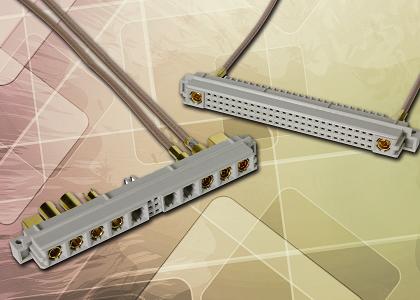
HARTING expands DIN 41612 connector family with M inverse connector style
07/05/2015 HARTING Ltd
HARTING has expanded its family of DIN 41612 connectors by adding devices in the M inverse style. This connector style is especially suited to implementing combined connections between circuit boards in which signal, coaxial, high-current (up to 40 A) or optical fibre transmissions need to be combined in one connector for greater flexibility.The new connector style is available in configurations with pole numbers of 78+2, 60+4, 42+6, 24+8 and 6+10, where the first number indicates the number of signal contacts and the second the number of special contacts. The 6+10 connector style in particular is completely new and enables up to ten special contacts to be integrated in one connector.
Users can combine connectors in a range of different configurations including both cable and circuit-board connections. Together with the established M connector, the new devices allow the implementation of mezzanine connections (two parallel circuit boards) and extender-card connections (two circuit boards lying side by side).
The range includes angled female connectors in solder technology and straight male connectors (headers) in solder, press-in or wire-wrap technology. The signal contacts are pre-mounted in a 2.54 mm grid, and can carry a load of up to 2 A per contact. They are tested in conformity with the IEC 60 603-2 standard.
To view the data sheet please click here
For more information, please contact:
HARTING Limited
Caswell Road
Brackmills Industrial Estate
Northampton
NN4 7PW
Tel: +44 1604 827500
Fax: +44 1604 706777
Email: gb@harting.com
Web: www.harting.co.uk
 Print this article
Process and Control Today are not responsible for the content of submitted or externally produced articles and images. Click here to email us about any errors or omissions contained within this article.