



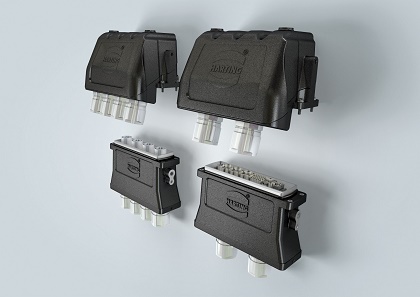
HARTING introduces Han® 34 HPR EasyCon connector for greater power density in rail vehicles
18/09/2017 HARTING Ltd
The new Han® 34 HPR EasyCon connector from HARTING is designed for high-current transmission with a high power density, making it ideally suited to use in rail vehicles.Han® 34 HPR housings and retaining frames are designed in such a way that, for the first time ever, a connector is now available that can accommodate four 650 A contacts alongside one another in a single interface. This more than doubles the connector's current-carrying capacity compared to the next HPR connector size down, saving space for the end-user. However, the housing dimensions have not increased to the same degree: the housing width is only a third more than the smaller alternative.
The new connector is available in an angled version for inter-car car transitions and a straight version for connections to traction units.
The housing also allows 12 individual Han-Modular® modules to be inserted as an alternative to the 650 A high-current contacts. Until now, two housings equipped with six Han-Modular® individual modules each had to be used to obtain a comparable power supply.
The Han-Modular® series offers over 100 different inserts for the transmission of power, signals and data, enabling a wide range of combination options. Intelligent modules in the smart Han® range complete the offering, including an ID module which gives rail components an identity that can be called up on networks. In addition, networks can be extended by integrating the new 4-port Ethernet switch US4, which uses minimum space.
For further information on the Han® HPR EasyCon high-current connector please click here.
For more information, please contact:
HARTING Limited
Caswell Road
Brackmills Industrial Estate
Northampton
NN4 7PW
Tel: +44 (0) 1604 827500
Fax: +44 (0) 1604 706777
Email: salesUK@HARTING.com
Web: www.harting.co.uk
 Print this article
Share article:
Process and Control Today are not responsible for the content of submitted or externally produced articles and images. Click here to email us about any errors or omissions contained within this article.