



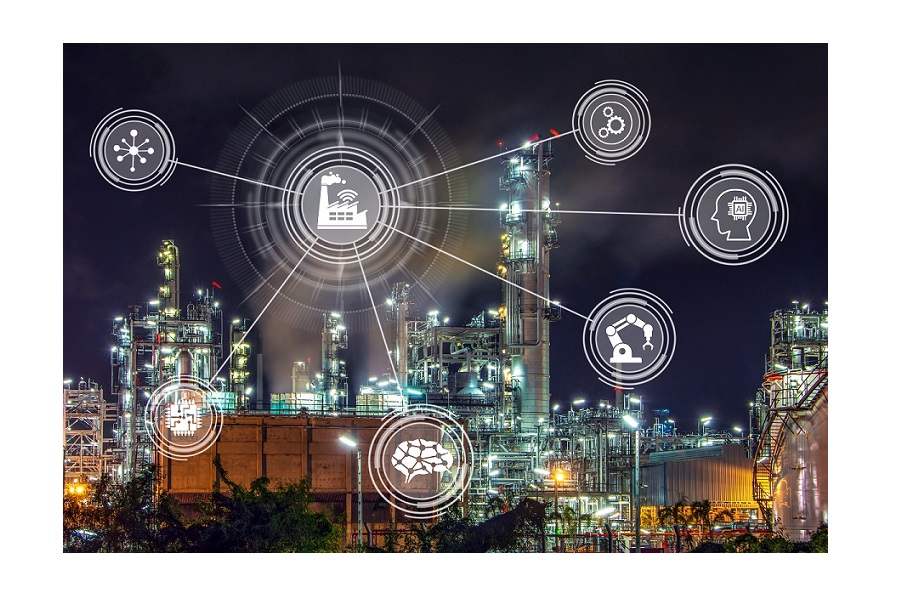
How Condition Monitoring is opening up new possibilities for Industry 4.0
14/11/2023 Fluke Reliability Solutions
Brian Harrison, Reliability industry lead for IIoT, Fluke, explains how condition monitoring is a stepping stone towards unlocking the benefits of Industry 4.0, without having to overhaul systems and processes.
The factory of the future, in which all conceivable devices are connected with their own intelligence and autonomyand each plant process is constantly optimized through sophisticated real-time analytics, has long been the utopia of industrial automation. It promises to unlock unseen levels of productivity and efficiency, while removing the need for humans to carry out many of the more repetitive or labour-intensive tasks required, potentially saving organisations vast amounts of money and time.
However, the idea of the smart factory is not yet a reality for all. It takes time, planning and often significant investment to radically modernise an entire plant from the ground up. Unfortunately, this can be beyond the reach of all but the largest and most well-resourced organisations. Rebuilding complex processes from scratch is often not affordable or feasible, while legacy equipment, which may still have plenty of life left in it, can be expensive to replace.
As well as requiring the latest technologies, a smart factory also requires a rethink in structure and culture in order to overcome compartmentalisation, organisational silos, and work habits that are no longer conducive to operational efficiency in the digital age.
In many cases a radical rebuild is not necessary in order to start embracing the benefits of Industry 4.0. Incremental improvements, such as by adding condition monitoring capabilities to existing equipment can unlock a vast potential for savings across the areas of efficiency, productivity and reliability throughout the plant.
The term “Industry 4.0” is in fact relatively new, originating in Germany in 2011 and becoming widely popularised by 2015. Whilst it means different things to different people, in general it refers to widespread adoption of new technological breakthroughs in robotics, AI, nanotechnology, quantum computing, and other technological breakthroughs. Crucially, it provides greater visibility over running processes, with digital connectivity providing real-time or near-real-time insight into asset health, allowing maintenance teams to focus their efforts on where they are needed, and not expend resources where it is not. It can also prevent large amounts of downtime by allowing potential issues to be flagged up and fixed before they turn into failures.
Condition monitoring does not require a substantial rethink of existing processes, and can be rolled out on a much smaller scale to embrace the efficiency, reliability and productivity savings promised by Industry 4.0, at a fraction of the cost.
Sensors are getting smarter
Sensors can be attached to legacy equipment to measure its health, tracking metrics such as vibration, temperature and power signatures which build a more complete picture of its condition without the need for manual inspection of every individual component on each device. This can significantly improve plant safety since assets in difficult to reach places or hazardous areas can be measured and analysed remotely without putting people in harm’s way.
Capturing this data is one thing, but using it to generate useful insights requires a more holistic approach. Many machines and closed-loop systems already have the provision for condition monitoring and analysis, but in order to put that data into context we need to transfer it into a higher-level operational framework, reaching beyond manufacturing execution systems (MES) and into enterprise asset management (EAM).
For operations, the goal is to radically improve machine health visibility by combining both current data and historical data to generate insights into plant maintenance and reliability. This can help to facilitate a shift away from reactive maintenance and towards more predictive maintenance, where maintenance is carried out specifically when and where it is needed. This in turn reduces the risk of maintenance activities introducing new problems that were previously not there.
Connectivity is key
The key to a successful condition monitoring plan is data connectivity; i.e. the flow of data from the monitor to the maintenance team’s software systems. Analytics solutions are only as sophisticated as the data back end that underpin them. In other words, the system is only as good as the data that goes into it, while context is also critical. For instance, real-time condition data will not necessarily tell you when an asset was last serviced, what actions were performed, or when maintenance is next due. Nor will it show the asset’s failure history, what parts are required to remedy any issues, and whether those parts are available. Digital connectivity can help to provide this context. Sensors on their own are useful, but limited in what they can achieve in providing useful insights across operations. Plugging the data into higher level control systems is where the real efficiency gains can be unlocked. Systems can also be optimised to reduce noise and nuisance alarms, ensuring that the right data is turned into useful information in a timely manner, and delivered to the person who needs to know it to inform better decision-making.
Once the relevant data has been collected, the system therefore needs to funnel it into a platform where it can be aggregated and integrated with data from other systems. This opens up the possibility of trend analysis, where issues can be identified, diagnosed, and ultimately predicted in the future before they turn into failures. The more that can be measured, and the more data that can be extracted from assets, the more potential variables can be analysed, uncovering underlying causes that may never have occurred to maintenance teams previously, and allowing steps to be taken to prevent them from occurring in the future.
Effective condition monitoring systems should include:
Data connectivity: Data is combined into a usable state and stored in an accessible location
System connectivity: Integration of asset health data with related systems used by maintenance teams
Team connectivity: All personnel have access to asset information, which allows for more efficient maintenance actions.
In summary
For many facilities, the factory of the future is not something that happens overnight. Ripping out and rebuilding entire systems is often not feasible, particularly for smaller enterprises. However, the technological building blocks required to unlock some of the benefits of the smart factory are already widely available. Sensors are coming down in price all the time and becoming more versatile and reliable, while improvements in networks and processing power are making sophisticated condition monitoring more accessible to a wider cohort of businesses that previously lacked the resources to explore it.
In effect, condition monitoring enables companies to start small, and grow digital capabilities gradually in a more manageable and cost-effective way. This also allows assets to be prioritised in a way that will provide the best return on investment. From there, condition monitoring programs can then be expanded to other operations, and before you know it much of the plant will be connected. From a practical perspective, this will enable an immediate improvement in maintenance efficiency, while longer term it can help to uncover and solve chronic or previously undetected issues and inefficiencies for better productivity and profitability in the future.
 Print this article
For more information, please contact:
Eric Betz
Fluke Reliability Solutions
Fluke Europe B.V.
PO Box 1186
5602 BD
Eindhoven
The Netherlands
Tel: +49 8999616 420
Email: eric.betz@fluke.com
Web: https://fluke.com/vibration
Share article:

Process and Control Today are not responsible for the content of submitted or externally produced articles and images. Click here to email us about any errors or omissions contained within this article.