



How To Choose The Right Air Compressor
06/01/2020 Direct Air & Pipework Ltd
By Emma Dolby, Marketing Manager at Direct AirAir compressors are an incredibly valuable tool in both industrial use and home DIY. There are many variations to choose from depending on the task at hand. They can power anything from pneumatic tools, scuba equipment, spray guns, snow machines and pump air into your tyres.
But how do we know which air compressor is right for us? Direct Air have created a guide on how to choose the right air compressor. Click here for more information.
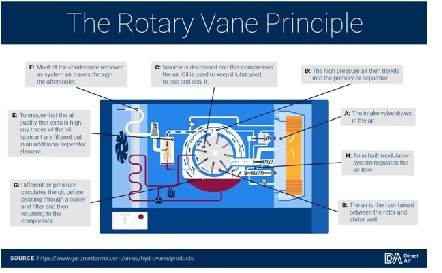
The above graphic shows the working of a rotary vane compressor, but there are even more to choose from.
Single Phase and Dual Phase Compressors
These are the most common form of air compressor, they operate in the same fundamental way, dual phase simply has one more step to the process.
A single phase air compressor contains one chamber to compress the air a single time, a dual phase has two chambers for a second round of compression.
A single phase compressor, also known as a piston air compressor, draws air into the cylinder through a single piston movement with the use of a vacuum system. The compression is measured in PSI (pounds per square inch) and is typically compressed at a rate of around 120 PSI. Once the air is compressed, it is sent to a seperate storage tank awaiting use.
A dual phase operates in exactly the same way but after initial compression, air is sent to a second tank for another round of compressions at a rate of around 175 PSI.
As they both work in a very similar fashion, both can be used for similar tasks. However, dual-phase are more robust and therefore may suit an industrial setting more than a single-phase.
Oil-Free and Oil-Lubricated Air Compressors
All air compressors require lubrication to be able to safely and efficiently draw in air. The machines can achieve this in one of two ways, oil or oil free.
An oil-free air compressor uses a non-stick coating, typically Teflon, to achieve lubrication. These machines are lightweight and require less maintenance. They also eradicate any risk of contamination from oil, making them an excellent tool for the medical and food industry. Click here to see the full range supplied by Direct Air.
Oil based air compressors are heavier due to added elements and require more maintenance to ensure sufficient oil levels. However, they do tend to have a longer life span as the oil-free non-stick coating will eventually wear down and require replacing.
Fixed and Variable Air Compressors
The main difference between these machines is the manner in which the motor gets its power. A variable speed compressor automatically adjusts the speed of the motor in accordance with the demand for air. This is achieved by converting AC power into DC power using diodes. The capacitor then cleans the AC and converts to DC using a transistor which acts as a switch. These switches control the frequency of the power which controls the speed of the motor.
This allows you to control the voltage and frequency in your motor and is more energy efficient as only the power you require is used. This saves you money on your energy bill and reduces your impact on the environment.
A fixed speed air compressor sends a constant flow of power to the motor which provides a reliable frequency to all your applications. They are cheaper in initial cost and easier to maintain.
Scroll Compressors
Scroll compressors are a form of piston compressor. They function with a piston that travels downwards and decreases pressure in the internal cylinder through the creation of a vacuum. Due to this sudden change in pressure, the door of the cylinder is forced open and draws air in. The piston travels back upwards and forces air out of the cylinder at a much higher pressure point and continues on a reciprocating 'scroll' pattern,
Scroll compressors cool down quickly and are more efficient in their energy use. However, they are higher in initial cost and have more complex components making them harder to maintain.
Rotary Screw Compressors
Instead of using a piston, rotary screw air compressors use rollers for their compressions. These rollers are positioned just off the middle of the central shaft, with one side in constant contact with the wall. These then rotate at an extreme speed to cause the same results as a scroll compressor.
Rotary screw compressors have good power capacity and lower initial cost, they are also easier to maintain. However, they do have limited cooling abilities and require continuous maintenance checks.
For more information, please contact:
Emma Dolby
Direct Air & Pipework Ltd
Unit 38
Herald Way
Binley Industrial Estate
Coventry
CV3 2RQ
Tel: 0808 164 9395
Email: enquiries@directair.co.uk
Web: www.directair.co.uk
 Print this article
Process and Control Today are not responsible for the content of submitted or externally produced articles and images. Click here to email us about any errors or omissions contained within this article.