



Industrial process heating: 4 opportunities to improve sustainability
08/12/2025 Babcock Wanson UK Ltd
By Etienne Fourie, Technical Sales Manager, Babcock Wanson
In order to limit the devastating effects of global warming and climate change, the UK has legally committed to reaching net zero by 2050, meaning that greenhouse gas (GHG) emissions will be equal to the emissions removed from the atmosphere. Industry is responsible for 13.7% of GHG emissions in the UK and, whilst strides have been made to reduce emissions, with 50% of industrial energy consumption still provided by fossil fuels, there’s a long way to go. The government’s Review of Energy Policy 2024 acknowledges that a comprehensive industrial strategy needs to be developed, with a strong focus on decarbonisation.
The Decarbonisation Pillars
So how do we decarbonise industry?
There are six pillars at the heart of decarbonisation:
- Circular economy
- Renewables
- Grid infrastructure
- Energy efficiency
- Sustainable mobility
- Energy communities
To decarbonise across all these pillars, we have to move from fossil fuels to electric primarily, with biofuel and hydrogen forming part of the mix. We also need to invest in carbon capture, utilisation, and storage, especially for mitigating emissions in sectors with limited alternatives (e.g. cement production), and we need to digitise our processes. The latter will enable us to enhance data processing for efficiency gains, faster problem-solving, predictive maintenance, and even virtual testing of solutions.
 Energy transition solutions for industry
Industrial organisations looking to improve sustainability in their process heating applications have four major opportunities available to them now to assist in this journey.
- Decarbonisation
Alternative solutions to the use of fossil fuels in steam and hot water production are readily available.
Electrification is by far the most popular and practical means of decarbonising. In light industry, heat pumps, electric resistance heaters and electrode boilers offer an efficient means for both direct and indirect heating. In hard to abate sectors, due to the high temperature heat requirements and the necessity to adapt heating technologies to cater to specific applications, solutions are sadly not as straightforward. However, across all industries, electricity costs and infrastructure are the main stumbling blocks in achieving electrification. Hybrid solutions that allow customers to use the best available energy source at any given time could be one way forward here.
Combustion solutions based on renewable energy such as hydrogen, biogas and oxycombustion are also on the table for consideration. Hydrogen may be necessary as part of the decarbonisation pathway for hard to abate industries, but the cost to transition from natural gas to hydrogen is considerable, and it has an increased tendency to form harmful NOx gases. Biofuels, on the other hand, are largely compatible with existing infrastructure but there is limited scope for increasing the scale of biomass production.
- Energy performance
Where low carbon solutions are not a practical option, focus on maximising the energy performance of existing boilers. There are several ways this can be achieved.
Firstly, ensure you have a modern energy efficient burner that is seamlessly matched with the heated vessel. The key to a good burner is its ability to provide very accurate control of excess air over the entire operating range, resulting in an excellent combustion efficiency no matter what the process load, and the lowest practicable operating costs. Our Modulo+ gas burners, for example, are designed with digital micro-modulation control and specially developed combustion head.
Secondly, adapt water treatment to the quality of the water available by ensuring the correct water treatment chemicals are used for the process at hand. Consider the use of ion exchange softening, thermal degassing (deaeration), and demineralisation by reverse osmosis or by resin exchange.
Thirdly, consider remote monitoring of heating systems which alert users to deviations in equipment operation and water quality enabling them to take action where required.
Combined, these actions reduce the consumption of fossil fuels, reducing NOx and CO2 emissions in the process.
- Reduction of polluting emissions
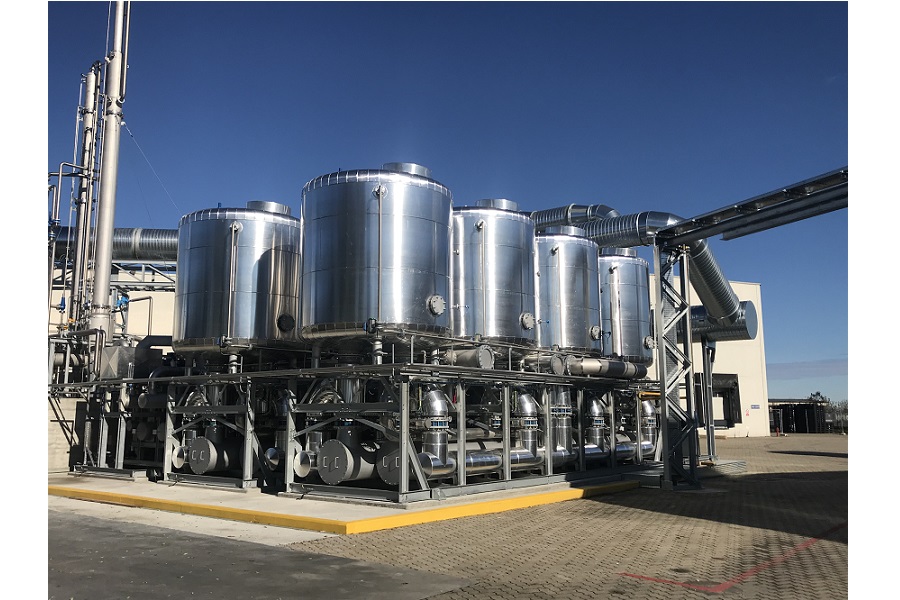
In addition to the actions listed above, polluting emissions can be reduced further through the adoption of equipment specifically designed to capture and eliminate air pollutants generated by industrial installations. Thermal oxidation solutions, including regenerative, recuperative and deodorising options, are highly effective at treating VOCs and odours. Pollutant gases are heated to a high temperature in a combustion chamber and are fully oxidised before being discharged as a harmless gas. Modern oxidisers incorporating adsorption technology concentration techniques can bring even the largest air volumes with low solvent loadings within reach of economic operation.
- Recovery and re-use
Look at best practice in managing natural resources.
When it comes to water management, consider implementing solutions to recover and reintegrate part of the water discharged, thereby reducing water consumption.
Waste heat recovery through the use of flue gas and condensing economisers is also ideal and can allow for considerable savings to be made. Economisers are essentially heat exchange devices that extract the residual heat from the exhaust gas generated by the combustion process. That recovered heat is usually fed back into the process, typically to the boiler feed water thereby optimising the overall efficiency of the plant in the most compact and cost-effective manner. Different types of economisers are available to meet a wide variety of processes and site needs.
Solvent recovery systems should also be considered to both help reduce your carbon foot print and meet increasingly stringent emission limits for solvents and VOCs. Solvent recovery systems that feature advanced distillation technology allow for a very high level of purity – frequently exceeding international standards - for the recovered solvents to then be reused in production, making for a rapid return on investment.
 The road to decarbonisation
People often refer to the road to decarbonisation, but the reality is there are multiple forks in the road and decisions to be made on which route to take. Each industry and each application face their own set of challenges, but options are available to help improve sustainability and get you one step closer to the net zero destination.
Babcock Wanson offers a complete range of products and services for boiler houses and other process heating needs.
 Print this article
For more information, please contact:
Etienne Fourie
Babcock Wanson UK Ltd
7 Elstree Way
Borehamwood
Hertfordshire
WD6 1SA
Tel: +44 (0)208 9537111
Email: info@babcock-wanson.co.uk
Web: https://www.babcock-wanson.com
Share article:

Process and Control Today are not responsible for the content of submitted or externally produced articles and images. Click here to email us about any errors or omissions contained within this article.