



Le Grand K and its influence on choosing the right battery partner for T&M equipment manufacturers
24/07/2019 Accutronics Ltd
In early 2019, scientists across the globe voted in favour of modernising the traditional definition of a kilogram. Historically, it had based on the weight of Le Grand K -۠a cylinder of platinum and iridium stored in a locked Parisian vault. Here, Neil Oliver, technical marketing manager at Accutronics, explains why designer engineers specifying batteries for test and measurement equipment should care.Test and measurement is based on agreement. Le Grand K was merely a block of metal that nineteenth century scientists agreed weighed a kilogram. The length of a metre is as it is because scientists agreed it should be one 10-millionth of the distance from the North Pole to the equator.
Similar universal agreements form the basis of every measurement, calculation and interrogation weperform. Every sample and communication, every unit of anything we monitor, relies on agreement.
But agreement is nothing without trust, which is why, when the International General Conference on Weights and Measures met in Versailles, France, to redefine the kilogram, they agreed on a measurement based on unchanging scientific principles. These principles are more trustworthy than the original hunk of metal, which could be damaged, or simply absorb atoms from the atmosphere, changing its weight.
We have to trust the process of calibration, which is why the original definition of each unit of measurement is so important. Then, once our instruments are calibrated, whether to a kilogram, meter or another measurable unit, we have to trust them too.
The measurement business
In a recent paper on Cleantech Measurement Applications, Richard Barker, the Head of Energy and Environment at the National Physical Laboratory in Middlesex, UK, said, "We need to validate the performance of innovative new environmental technologies, to ensure that businesses can prove their claims to investors and customers."
Barker has hit the crux of the issue; in order to sell anything to anyone we need to be able to assure the validity of that thing. For example, when we predict environmental conditions (from oceanic changes to earthquakes) or when we release a product to market,we have to be certain that we've tested it correctly.
Putting trust in design
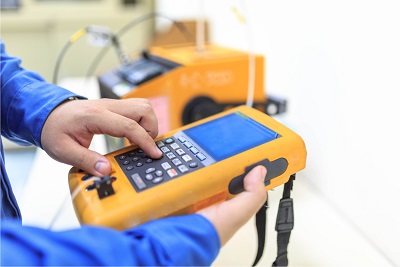
To ensure the reliability that underpins trust, the design of test and measurement equipment must consider the typical environments in which it could be used. For example, a design engineer working on a portable ultrasonic flaw detector would have to consider the inspection environment, which could encompassextreme temperatures or the risk of ingress, as well as the location and typical cycle of work the equipment is used in.
Like every design engineer, they would also have to consider the constant pressure to make the device smaller and its usable lifespan longer. This is true of every portable test and measurement device, from healthcare applications to the military and multimeters to oscilloscopes.
Choosing the correct battery is one of the key ways of meeting these challenges. As a result, at Accutronics, we launched our Accupro custom battery packdesign, engineering and manufacturing service. Since the launch, we've helped countless design engineers specifying batteries for test and measurement equipment make their devices smaller, more portable, able to operate at a wider temperature range and, crucially, more trustworthy.
This complements the growing accuracy of the measurements themselves. For the foreseeable future, the kilogram will be described using the speed of light, time and Planck's constant, which defines the energy of a photon of light, given its wavelength. Planck's constant is approximately 6.626 x 10⁻³⁴ joule-second. It sounds pretty trustworthy to me.
Neil Oliver has worked in the battery industry for nearly thirty years and has written countless articles on battery design and testing. To find out more about the Accupro service, you can watch a simple explainer video on bespoke battery design and manufacture here.
For more information, please contact:
Neil Oliver or Michele Windsor
Accutronics Ltd
Unit 20 Loomer Road
Chesterton
Newcastle-under-Lyme
Staffordshire
ST5 7LB
United Kingdom
Tel: +44 (0) 1782 566 622
Fax: +44 (0) 1782 566 354
Email: neil.oliver@accutronics.co.uk
Web: www.accutronics.co.uk/index.php
 Print this article
Share article:

Process and Control Today are not responsible for the content of submitted or externally produced articles and images. Click here to email us about any errors or omissions contained within this article.