



Lenze proves drives don't' have to be like a box of chocolates - with the right drive, you know exactly what you're gonna get.
16/02/2018 Lenze Ltd
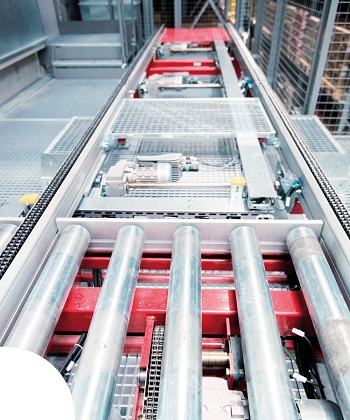
Tradition blends with advanced drive technology, as chocolatier Camille Bloch overcomes production expansion challenges posed by limited warehouse space.Originally, the Ragusa brand of chocolate was only sold as a 50g bar with whole hazelnuts in a praline filling, coated with a fine layer of chocolate. Today Ragusa is the key brand of chocolatier Camille Bloch and represents a Swiss chocolatier tradition going back almost 90 years. The family-run company, based in Courtelary, Switzerland, is currently investing in a logistics centre. Lenze Smart Motors drive the roller conveyors in the system built by material handling specialist Stöcklin Logistics.
Camille Bloch is a typical example of a traditional family-run company, which enjoys sustainable growth and has achieved long-term success. Founded in Berne in 1929, the company is run in the third generation by Daniel Bloch and annually produces around 3,700 tons of chocolate specialities. At the Courtelary site, an established factory in a rural area, there are over 180 people who work there. Traditional recipes meet modern technology and Camille Bloch has plenty more ideas for the future, as reflected in the ambitious building projects currently in the pipeline.
Compared to new green-field buildings, extending existing production facilities always brings the challenge of limited space which restrict the potential expansion. A glance at Camille Bloch's warehouse for raw materials and finished goods soon makes this clear. Aware of the space limitations, material flow experts from Stöcklin design their horizontal material flow systems as compactly as possible, while at the same time avoiding any compromises on function or ease of installation.
Function and efficiency in a minimum of space
In practical terms, this meant accommodating two drives under a roller conveyor with lift function. As Oliver Colombo, Stöcklin Area Manager for materials handling technology explains, "One geared motor drives the rollers while the other drives the lift via an eccentric cam." A significant benefit of the Lenze Smart Motor is that it is one frame smaller than a comparable mains-operated drive.
With a shortage of available space, the Lenze Smart Motor fits the bill, with high power density largely thanks to its four-fold torque overload capacity. Lenze incorporated this feature on the drive aimed specifically at material handling, because starting torque is an important aspect of dimensioning for conveyors.
"If we want to convey pallets, we need energy. However, because the drives don't run continuously, I always have to consider how to do the job as smartly as possible, while expending as little energy as necessary," adds Colombo. While in the past the comparatively high starting torques could only be achieved with a drive scaled up to meet the demand, the Lenze Smart Motor meets short-term needs for maximum power by briefly increasing its output torque four-fold.
The drive electronics thus deliver sufficient power for the ramp-up, and the geared motor need only be designed for regular operation. "Once the pallets are on the move, there only needs to be very little energy on the line compared to starting. This drive solution is a real benefit because we can build on a smaller scale, use less expensive drives and at the same time achieve greater energy efficiency," says Colombo, summarising the benefits of the Lenze Smart Motor.
Smart and simple: variable fixed speeds
Another bonus of the mechatronic units is the PLC-controlled selection using a digital signal of four different speeds - for example these could be two forward and two reverse speeds. Should an application call for speed adjustment, this can be performed effortlessly with the Lenze app via a NFC (Near Field Communication) interface.
Not only the speed, but also the time of the start and stop ramps and the motor's direction of rotation can be set. Deeming the reversing option as a further criterion for selection, Swiss logistics expert Stöcklin opted for the Lenze Smart Motor. "We get a drive that is similarly priced to other manufacturers' products -ˆ' but offers more functions for our money."
Exploring new avenues in logistics
On completion of the project more than 120 of these mechatronic logistics drives will go into operation at Camille Bloch. They are integrated into chain and roller conveyors, pallet lifts and loading stations for raw materials and finished products. The various speed and torque requirements no longer result in a great variation of the drives. Compared to conventional fixed-speed geared motors, variants are reduced by up to 70 percent. For production companies like Camille Bloch this lets them stock far fewer spare drives thanks to the variable fixed speed that can be set with Lenze's g350.
As Werner Prysi, Maintenance Manager at Camille Bloch, concludes: "We like it best having the same drive for everything where possible, especially one that can be easily replaced with no need for an engineer to do the job." Werner also expects the technology deployed to operate reliably, especially given the fact that there is only limited space for redundancy systems. And if a drive does need to be replaced, the job must be completely quickly. Lenze Smart Motors are thus equipped with plug fittings, the replacement motor can also be swiftly configured because all the settings can be read offline using NFC from unit being replaced. These settings are then saved in the Lenze app for loading into the new motor and the job is done.
Outlook: NFC just the beginning
Oliver Colombo thinks NFC is a good option, and one that will continue to evolve, although he is unable to predict how industrial communication will develop in the future. No matter how practical they may be, the expense of wireless connections will always remain an issue; Colombo said, "In materials handling we talk about space costs in relation to the number of pallets they can accommodate."
Costs include the steel structure, all mechanical parts, motor, installation technology, software and assembly time. Colombo added, "New functions are always promising, but the market must be able to draw a benefit from them when calculating total cost of ownership."
Total cost of ownership is precisely the aspect that is well-served by the Lenze Smart Motor, which offers the materials handling sector an innovative drive solution.
For more information, please contact:
Lenze Ltd
Fraser Rd
Priory Business Park
Bedford
Bedfordshire
MK44 3WH
Tel: +44 (0)1234 753200
Fax: +44 (0)1234 753220
Email: sales.uk@lenze.com
Web: www.lenze.com
 Print this article
Share article:

Process and Control Today are not responsible for the content of submitted or externally produced articles and images. Click here to email us about any errors or omissions contained within this article.