


Leveraging finance for digital transformation: OEM/vendor criteria for choosing the best financing partner
21/05/2025 Siemens Financial Services GmbH
John Bolton, Sales Manager, Industry, Siemens Financial Services
Drivers and challenges for digital transformation
Today’s pressures on manufacturing equipment companies are immense.
Input prices have risen for manufacturing technology companies (‘OEMs’ or ‘vendors’). Energy costs are significantly higher than pre-pandemic. The cost of raw materials and components has inflated. Supply chains have been disrupted and are being restructured to mitigate geopolitical risk New governments across the globe are creating further uncertainties. And the manufacturing sector itself - the users of OEMs’ manufacturing machines – is experiencing a softening of demand in many parts of the world. The global perspective is important, because most manufacturing equipment OEMs serve international markets.
Let’s just say that the market outlook is challenging.
At the same time, though, drivers of demand are also growing.
In particular, digital transformation – the drive to Industry 4.0 – is widely recognised as a ‘must do’ for manufacturers. And that means adopting and investing in new, digitalised manufacturing equipment. There is wide consensus that the cost savings, production efficiencies and competitive advantage to be gained from digitalisation cannot be ignored.
In addition, mandatory corporate sustainability reporting standards are driving demand for more sustainable production (and post-production) machines. In fact, digitally enabled equipment is the technology platform that enables more sustainable production capabilities – less energy use, lower volumes of raw materials, fewer defects, improved uptime through remote maintenance, and so on. Digitalisation and sustainability are two aspects of the same trend – symbiotic, interdependent.
Government is also behind the transition to digitalized manufacturing and climate targets. A new subsidy and tax-break regime was introduced at the last budget, along with major infrastructural developments around clean hydrogen power.
Transformation requires investment
Yet despite these positive influences – the clear commercial advantages of digital transformation in manufacturing, underpinned by government support – manufacturers still remain hesitant in many cases to commit to the substantial capital investments required. Manufacturers are not keen to tie up their precious funds in capital equipment that will take some years to deliver full return on investment and more.
This hesitancy is understandable. An analysis from Siemens Financial Services (SFS) of the manufacturing sector as a whole shows that headwinds (negative factors) – especially rising input and labour costs – have inflated more than tailwinds (positive factors such as production and confidence) in the sector.
Nevertheless, the need for manufacturers to invest in digital transformation will not go away. It cannot be ignored. Therefore, OEMs need every technique in the box to help their manufacturing customers feel confident and capable of investing.
Integrated financing boosts sales
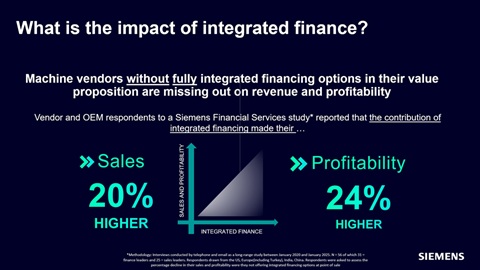
Embedding flexible financing options is one of the most powerful ways of making investment in new-generation equipment palatable, and financially sustainable. For example, in a recent SFS research project among international manufacturing equipment OEMs, 66% said that integrated finance options helped them sell more machines from their sustainable portfolios. On the more general level, another SFS research project revealed that OEMs said integrated finance enabled 20% more sales revenue, and 24% more profitability, than if products were offered without these financing options[iv].
So the broad view from the manufacturing equipment OEM community is that flexible financing options certainly get more deals over the line, by helping the manufacturing customer spread the cost over time – in alignment with the flow of benefits being received from the investment – and keeping the manufacturer’s cash free and liquid for agile sales or business growth initiatives.
But how do you choose the right financing partner?
The key question, then, is who to partner with? What are the qualities of a financing partner that will most benefit the OEM? To help the OEM community consider this critical question, we have laid out a few criteria that can help make that choice.
- Technology and market know-how
Knowing how manufacturing technology works helps assess the likely business outcomes that a manufacturer will achieve by investing in each machine or equipment solution. Does your financing partner have that in-depth sector knowledge? Such expertise is critical to their ability to structure a financing arrangement so that it truly fits the customer’s cash-flow profile and aligns payments to likely commercial outcomes. It is a fundamental building block for optimising revenues and profits. And can your financing partner establish ‘master’ agreements, making it easier and quicker for the customer to acquire further pieces of equipment in the future?
- Full range of financing tools
Sales finance needs to be combined with powerful cash flow management tools. Does your financing partner offer ways of delaying payment for machine building components until you are close to selling the final equipment product? These kind of extended payment terms help vendors/OEMs to meet rising demand without hitting any cash flow obstacles.
Key takeaways
The evidence proving flexible financing can improve sales is strong and increasingly recognised. As various ‘headwinds’ – input costs, labour costs, inflation, market uncertainty, etc – provide challenges, it is imperative for OEMs and vendors to deploy every aspect of a compelling value proposition to help manufacturing customers invest in the future – whether digital transformation or sustainability goals. A financing partner that can support manufacturing equipment sales with flexible, appropriate financing tools and expertise will make a major commercial difference. The critical factor is to choose that financing partner with care!
Find out more at siemens.co.uk/financialservices
 Print this article
For more information, please contact:
Siemens Financial Services GmbH
Werner-von-Siemens-Straße 1
80333 Munich
Germany
Tel:
Email:
Web: https://www.siemens.com/finance
Share article:

Process and Control Today are not responsible for the content of submitted or externally produced articles and images. Click here to email us about any errors or omissions contained within this article.