

MANAGING ASSETS FROM THE CLOUDS
12/09/2011 HMS Industrial Networks Ltd
Engineers are always under pressure to reduce costs, improve quality and optimise plant utilisation, but as the saying goes, if you can't measure it, you can't control it. Stuart Hannah of HMS Industrial Networks explains how the use of cloud computing and the Internet make remote management of your plant and assets a much simpler and more attractive proposition than in the past.As markets become tougher and companies seek to improve their competitiveness, there is an increasing need to monitor where assets are and what is happening with them, and to use this knowledge to improve performance.
Many companies already do this, for example by using supervisory control and data acquisition (SCADA) software, although this can become both complex and expensive for multiple locations. Now however, the simplification of remote monitoring technology makes it viable to monitor anything from a single device (such as a PLC or Frequency Inverter) to multiple installations spread across the globe safely and securely. Issues regarding security of the data and access to it are important features of any system, particularly where the Internet is involved.
The trend for remote monitoring systems is towards the use of cloud computing. Cloud computing is simply the term used when services such as infrastructure, applications and business processes are delivered on demand using remote servers accessed via the Internet. The big advantage of providing software as a service (SaaS) in this way is that it is scalable (both up and down), reliable and easily accessible. Importantly, new applications can be trialled, deployed and shared quickly and easily. Decision making and implementation can also be faster as there is no capital expenditure needed, and the resources can be used to complement or replace the user's own ICT infrastructure.
Improved access to information is the main benefit leading to the saving of time, improving performance and saving resources. From any computer or mobile device with an Internet connection you can see what's happening 24/7. Furthermore, if there are any problems you can instantly receive alarm emails or text messages, so if equipment starts to function out of parameters you can be notified and react before failure occurs. You can log historical data and produce graphical trends, automatically backup or restore remote configurations, and even can track/monitor vehicle locations and record their loading or status in real-time.
How it works
There are three main elements to any cloud based remote monitoring solution. The first is the physical layer that comprises of communication gateway devices that link to your equipment, acquire the data, and communicate it to the remote server. The second is the remote server that collects and stores the data, and the third is secure access to the data through a customised online dashboard.
Communication gateway devices take several forms for ease of connection to the device or equipment being monitored. The connection is generally through serial communications or by using a popular open protocol such as Modbus RTU. Additional functionalities such as global positioning systems (GPS) are available to meet the demands for location based services (LBS) like tracking and geofencing (providing notification when a tracked device enters or leaves a predetermined geographical location).
Acquired data is sent to the remote server by the gateway devices at selected logging intervals ranging from real-time to 300 seconds as demanded by the application. To communicate with the server, gateways generally use either quad-band GSM/GPRS wireless technologies or Ethernet TCP/IP connections: both may be used concurrently on the same installation. GSM (Global Systems for Mobile Communications) is the most widely used technology for mobile communications, whereas GPRS (General Packet Radio Service) is a newer function integrated into GSM that allows for the simultaneous transmission of high speed data across a mobile telephone network. The costs for data only transmissions using GPRS are significantly lower than for voice calls. To ensure that communication using wireless GPRS is secure, dedicated SIM cards are an option (if security is not an issue normal data enabled SIM cards can be used). This means it is not possible to ping or try to access the remote site except through the data centre and avoids unnecessary GPRS traffic.
Where the communication gateways use Ethernet based connectivity it is normally via wide/local area networks (WAN/LAN) with direct connection to the server via the Internet. The use of special firewall friendly communications between the remote gateways and the data centre makes it possible to retain the existing broadband security infrastructure at the customer's site. This procedure is accepted by most IT departments and gives confidence that the installation is controlled from a security perspective. Communication gateway devices are normally pre-configured and require no programming or IT expertise, so neither virtual private network (VPN) nor static IP addresses are needed.
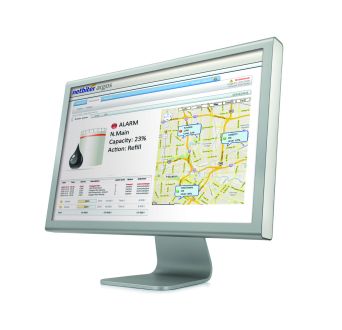
Data is communicated to and stored on a remote server. In the case of HMS's Netbiter Argos 3 solution the server is located at one of three data centres and the data backed up at the other two. Information held there can be displayed graphically in the form of customised dashboards, or downloaded into the customer's businesses management system for analysis and reporting. All server activity is logged at a password holder level.
Information on the server is viewed using a standard web browser. To simplify configuration of the graphical display, standard tools are incorporated into the server. These include downloadable device templates for establishing communications between the remote plant and the communicating device and auto web pages (dashboards). Some systems contain libraries of ready-made web page dashboards for applications such as power generators, water/waste management, base stations, building and HVAC management and many more.
User access is controlled by multi-level passwords, which are linked to a user profile to define the level of information or control available. Access is available from any location via the Internet using any suitable PC or mobile device such as a Smartphone, tablet or similar, and because the dashboard is displayed on a standard web browser no special software is required by the user. This makes it convenient for field service staff or business managers away from base.
Access to the server information means users can log historical data and produce graphical trends or diagnostics, manage alarms, or automatically backup or restore remote configurations. Although not originally conceived as a SCADA package, the functionality exists to easily configure one. The servers data can also be accessed by the users own ERP system for further analysis and reporting.
Stand-alone applications
For monitoring and controlling simple stand-alone equipment not required to communicate with the central server, a range of communication gateways with integrated web server functionality are often used. These can be wired or wireless types, and support for an external GPS receiver means that it is also possible to identify the location of the equipment. This can be particularly useful for fleets of rental machines such as standby generators.
In addition to handling communications, these devices will often provide built-in features for data logging, alarm handling (via email of SMS messaging), and configurable web pages for monitoring and control from remote locations via the Internet without special tools or software.
Applications
Anywhere information from remote locations needs to be collected and analysed has the potential to use remote monitoring. It can reduce costs and improve equipment performance by flagging problems at an early stage and optimise maintenance programmes. Popular applications include:
* the monitoring of fuel, oil, battery condition of standby generators
* tank management to monitor levels and temperatures, schedule refills and optimise logistics
* remote pumping station monitoring to notify if service interruptions, unauthorised entry, and reduce routine service visits
* in building automation to optimise energy consumption, monitor HVAC and security
Remote management can be integrated into new equipment to provide customers with enhanced functionality and services, or added to existing fixed or moving assets. It helps avoid unnecessary travelling of service personnel to remote locations as emergency visits can often be avoided. It saves time, money and offers businesses the opportunity to provide new services, and it's simple to implement.
For further information, please contact:
Mr. David Folley
Tel:+44 (0) 7557 921172
Email: dfo@hms.se
HMS Industrial Networks Ltd
The Venture Centre
Sir William Lyons Road
Warwick University Science Park
Coventry CV4 7EZ
UK
www.anybus.com
 Print this article
Process and Control Today are not responsible for the content of submitted or externally produced articles and images. Click here to email us about any errors or omissions contained within this article.