



New High Reliability Slip Ring Brings New Technology to Wind Turbines
03/10/2016 Moog Controls Ltd
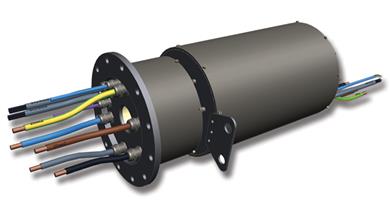
Moog Components Group Limited, a division of Moog Inc., has announced the introduction of a new pitch control slip ring. The EPA3 slip ring is the next generation of advanced slip ring products specifically developed for the wind energy market. It is well suited for both large and small wind turbines.A key advantage of the Moog slip ring is its high reliability, modular design that can be scaled and optimized for most requirements. The slip ring provides the most advanced contact technology available in the market while extending the life of the product to reduce field maintenance. No maintenance (cleaning) is required.
The slip ring can be part of a large wind turbine electric pitch control system with the option to integrate hydraulic pitch control systems if required. It can also be used on the yaw axis of small wind turbines. Speeds range from 0 to 100 rpm with through-bore model sizes up to 54 mm available.
Building on Moog's heritage in the wind turbine market, this new product offers customers a technically more advanced slip ring solution with extended life at a lower cost of ownership. The slip ring utilizes Fiber On Tip (FOT) power contacting technology. The new flexible design is easier to manufacture than conventional slip rings and decreases time to market.
In addition to wind turbine applications, the new slip ring can also be used in industrial machinery and medical equipment.
For more information, please contact:
Marie-Laure Gelin
Moog
Tel: +31 (0)252 462 034
Fax: +31 (0)252 462 001
Email: mlgelin@moog.com
Web: www.moog.com/products/slip-rings.html
 Print this article
Share article:

Process and Control Today are not responsible for the content of submitted or externally produced articles and images. Click here to email us about any errors or omissions contained within this article.