



Overcoming Logistical Challenges to Upgrade Critical Cooling Systems for a Hospital in Scotland
30/09/2024 ICS Cool Energy Ltd
Reliable temperature control systems are critical to the smooth operation of any healthcare facility, ensuring that essential medical equipment, sensitive medications, and hospital environments are maintained at precise temperatures. In operating theatres, laboratories, and storage areas, temperature control is essential to prevent equipment failure, ensure patient comfort, and safeguard the quality of critical supplies like vaccines or pharmaceuticals. For these reasons, hospitals rely on efficient cooling systems that deliver consistent performance even under challenging conditions.
The Challenge:
In a hospital in Scotland, the outdated cooling infrastructure serving the operating theatres, was posing a risk to ongoing operations. The hospital urgently needed a reliable and efficient replacement system to avoid potential issues.
The hospital specified a cooling capacity requirement of 80kW for chillers located indoors in a 30? ambient temperature. However, the plant room's location on the upper floors of the building created logistical challenges for equipment dismantling, transport and installation of the new one.
The Solution:
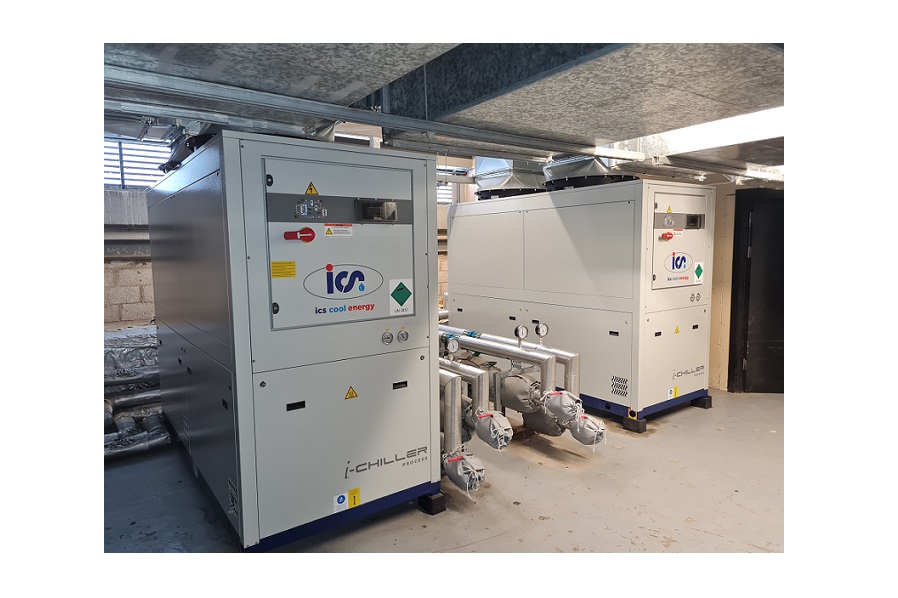
Tasked with the challenge, ICS Cool Energy developed a plan to remove the old equipment and install new chiller systems in the hospital's covered plant room. Due to limited access and the challenge of transporting large equipment to the upper floors, several site visits were conducted to assess the layout, identify potential obstacles, and establish an effective work process.
To meet the hospital’s cooling requirements, ICS Cool Energy selected two i-Chiller 80kW units. The selected chillers were transferred from ICS Cool Energy's central storage in Totton to their workshop in Bradford, where the units were de-gassed, disassembled, and flat-packed onto pallets to facilitate easier transport. The flat-packed components were then shipped to the hospital's loading area, from where, they were transferred manually to the fourth-floor chiller plant room via internal lifts. A manual lift and shift team then laid out the components for on-site reassembly by ICS Cool Energy engineers.
After reassembly, the system was recharged with refrigerant, tested and commissioned following the completion of pipefitting, fluid filling, electrical supplies, and ducting.
ICS Cool Energy also issued Waste Transfer Notes for the redundant equipment, refrigerant and oil.
Al Sorley, sales engineer at ICS Cool Energy: "One of the primary challenges was transporting and installing the new chillers. Due to the restricted access to the fourth-floor plant room, we had to disassemble the chillers for transport and then reassemble them on-site. This complex logistical process required precise planning and coordination to ensure minimal disruption to hospital operations, especially in critical areas like the operating theatre.”
The Result:
ICS Cool Energy demonstrated its expertise in providing tailored solutions by selecting and installing a system that met the hospital’s specific cooling requirements. By overcoming the complex logistics of disassembling, transporting, and reassembling the chillers in a restricted-access area, ICS Cool Energy minimised disruption and completed the installation efficiently. The hospital now benefits from a reliable, energy-efficient cooling system, ensuring long-term operational stability and reduced risk of equipment failure, enhancing patient care and safety.
For more information on ICS Cool Energy complete process temperature control solutions, please visit www.icscoolenergy.com/.
 Print this article
For more information, please contact:
ICS Cool Energy Ltd
ICS House
Stephenson Road
Calmore Industrial Estate, Totton
Southampton
Hampshire
SO40 3RY
Tel: +44 (0)23 8052 7300
Email: info@icscoolenergy.com
Web: https://www.icscoolenergy.com
Share article:

Process and Control Today are not responsible for the content of submitted or externally produced articles and images. Click here to email us about any errors or omissions contained within this article.