



Palintest on the best options for testing free chlorine when superchlorinating fresh produce
24/08/2016 Palintest Ltd
When processing fresh-cut produce like lettuce, disinfection is often carried out by adding free chlorine, in the form of hypochlorite, to the wash water.Many standards stipulate that free chlorine must be maintained in the wash water at concentrations greater than 50 mg/l. This process, known as 'superchlorination', aims to avoid the formation of chloramines (also known as combined chlorine), which are formed when free chlorine reacts with nitrogenous compounds in the water, such as ammonia. Chloramines are weaker disinfectants than free chlorine.
Currently there is no one perfect method to specifically measure free chlorine at superchlorination levels. However, Palintest offers a number of options for users aiming for superchlorination. These include the ChloroSense® method, the Iodometric Colorimetric method and the DPD Colorimetric method. Which one is used will depend on local circumstances and requirements.
1 ChloroSense® method
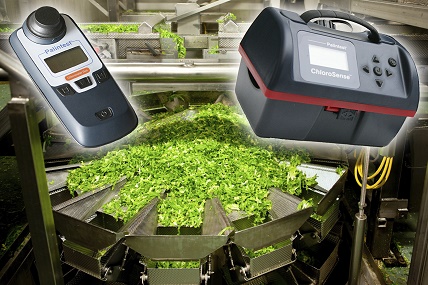
ChloroSense® uses an electrochemical technique called chronoamperometry and includes an instrument and a disposable pre-calibrated sensor, allowing non-technical users to rapidly obtain accurate results. Although the device provides a free chlorine reading (up to 10 mg/l), operators can use the total chlorine reading (up to 100 mg/l) to demonstrate superchlorination has been achieved. Additionally, ChloroSense® is glass- and reagent-free and ensures traceability with integrated data logging, making it ideal for use in high-care and GMP environments.
2 Iodometric Colorimetric method
Another method for determining total chlorine can be carried out using Palintest's Chlorometer Duo. This is a colorimetric version of a standard method allowing total chlorine readings up to 250 mg/l - again demonstrating superchlorination has been achieved.
3 DPD Colorimetric method
The DPD method is also available on Palintest's Chlorometer Duo and has been the standard method for determining free and total chlorine in water for over fifty years. However, it has a limited test range (0 - 5 mg/l), meaning dilution on the production line is required.
In most applications where water is expected to be maintained at superchlorination levels, the ChloroSense® or the Chlorometer Duo are proven and straightforward approaches to demonstrating effective disinfection is taking place.
For more information, please contact:
Tom Aylward
Communications Manager
Palintest Limited
Palintest House
Kingsway
Team Valley
Gateshead
Tyne & Wear
NE11 0NS
United Kingdom
Tel: +44 191 491 0808
Email: Tom.Aylward@Palintest.com
Web: www.palintest.com
 Print this article
Share article:

Process and Control Today are not responsible for the content of submitted or externally produced articles and images. Click here to email us about any errors or omissions contained within this article.