


Perceptive Engineering on the Latest Developments in Advanced Process Control in evaporator/spray drying
14/01/2016 Perceptive Engineering Limited
Spray drying is used in the manufacture of a wide range of high-value items, from dairy products to food flavourings to pharmaceutical ingredients. It is a complex and energy-intensive process, requiring high levels of manual intervention from well-trained, experienced operators. To remove water safely - without damaging critical product properties - requires significant capital investment. But once the plant is running, it can be difficult to increase capacity as demand grows.In the sectors where they are deployed, spray dryers are the most energy-hungry components of water removal. A typical multi-effect evaporator will extract as much as ten times the amount of water from the product for the same amount of energy as the dryer. Therefore, it is vital to fully optimise evaporator performance as the first stage of process improvement. This has to be done carefully as changes to evaporator operation will have an immediate effect on dryer performance and - hence - product quality.
Perceptive Engineering has developed a suite of software and engineering tools to increase the yield, throughput and efficiency of the entire drying process, resulting in lower energy consumption, more consistent product quality and less waste. This software-based upgrade is a low-cost, low risk alternative to capital expansion, typically offering a return on investment of 3-6 months.
Both the dryer and evaporator have three key phases of operation: the crucial start-up phase, when product feed is first introduced to the process unit; normal operation, when disturbances such as tank changes and shifts in ambient temperature or humidity give rise to process and quality upsets; unit shut-down, when the feed product transitions from concentrate back to water.
This article will describe one of the solutions developed to address the first critical stage: process start-up.
OPERATIONAL CHALLENGES - START-UP
Each production unit is brought online through a series of small, carefully-controlled step-changes. Feed solids transition quickly from water to product. With the Evaporator, the challenge is to avoid conditions that increase the risk of fouling. An over-aggressive start-up on the evaporator will increase fouling very early in the production run; this will shorten overall run-time before cleaning is required, reducing overall equipment effectiveness. Early fouling also affects heat transfer, meaning higher energy consumption throughout the cycle, or lower throughput.
In the dryer, aggressive starts frequently lead to either scorched product which fails quality tests, or over-moist product which blocks the dryer. Either way, production capacity is severely compromised and waste or re-work rates are high.
Slow, carefully-managed start-ups can avoid these issues, but they extend the time delay between batch or grade changes. As manufacturers look to increase agility and reduce operating costs, and as new formulations come along that are more challenging to dry, these issues must be addressed more elegantly.
Model predictive control (MPC) has been used in the optimisation of spray dryers and evaporators for more than twenty years. Through a series of response step tests and using sophisticated modelling techniques, MPC can determine in advance the sequence of control moves necessary to push the evaporator or dryer closer to their constraints, then keep them there - even when disturbances like tank or batch changes are upsetting the process. MPC is able to execute multiple coordinated control moves, many times a minute, continuously during production. This constant fine tuning of the process could not be achieved in the PLC and would be impossible for an operator to replicate, which is why more manufacturers are exploiting the technology to gain a competitive edge.
Perceptive are renowned experts in deploying MPC programmes for a wide range of global clients. They have been selected by Abbott Nutrition, Danone and Wyeth as APC provider for the manufacture of high-value infant formula in North America, Europe, Singapore and China.
Perceptive Engineering has now perfected the techniques for taking control of both the evaporator and dryer much earlier in the production cycle, by modelling - then optimising - each unit as it moves through the start-up phase and on to stable operation. This expertise has been captured in the latest release of Perceptive's award-winning software.
The system runs within a standard Windows® environment and interfaces to client systems using standard protocols such as OPC or ODBC.
Evaporator Start-up
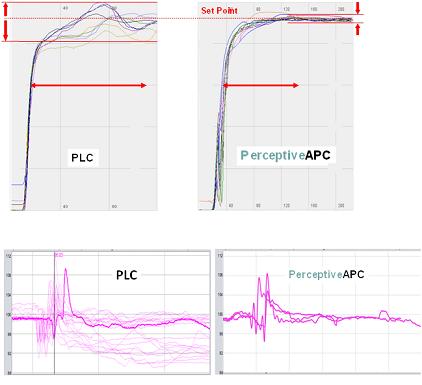
The trend (pictured top left) shows solids levels from the final effect of the evaporator, with multiple starts overlaid on the same trend. Despite the operator running the plant cautiously, some of the start-ups overshoot, recording solids levels that are too high and which will give rise to increased fouling and compromised efficiency. When the same evaporator is started with advanced control (right), overshoot is minimised and the time taken to reach stable, on-spec operation is reduced by as much as 40%. As well as improved efficiency throughout the run, the faster start permits much more agile manufacturing with shorter turnaround and less wasteful grade or product changes.
Dryer Start-up
In this example, (pictured bottom) exhaust air temperature gives an excellent indication of the variability observed during different dryer starts. Again, the trend on the left is plotted from multiple separate production runs and exhibits a wide spread of control.
One of the main advantages conferred by Advanced Control (right) is greater consistency of operation - a higher level of repeatability between production runs, even when other process disturbances are present.
For the dryer, MPC delivers a 50% reduction in the time required to achieve stabilised operation, defined as temperatures and production rate at setpoint, with expected product quality being achieved. In addition, the time to bring all six nozzles on line was reduced by 16%. Again, this provides far greater agility for dryers with a high number of product changes in their schedule, and more reliable, efficient operation for dryers with longer run times between CIP.
For more information, please contact:
Simon Mazier
Perceptive Engineering Limited
Vanguard House
Keckwick Lane
Sci Tech Daresbury
Cheshire
WA4 4AB
Tel: +44 1925 607150
Email: info@perceptiveapc.com
Web: www.perceptiveapc.com
 Print this article
Share article:
Process and Control Today are not responsible for the content of submitted or externally produced articles and images. Click here to email us about any errors or omissions contained within this article.