



PHASE VISION SUPPORTS RACECAR ENGINEERS OF THE FUTURE
03/02/2011 Phase Vision Ltd
In any motor racing environment, cutting build time to increase the time available for testing is integral to the overall long-term success of the team.Whether it's Formula 1, IndyCar, or amateur stock car racing, there is simply no substitute for time out on the track to allow final refinements to be made to ensure optimum performance on race day.
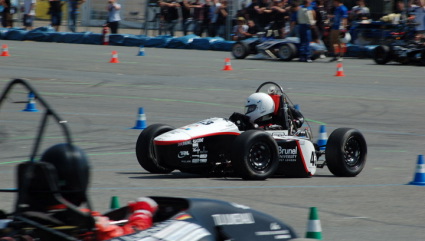
When the Brunel Racing team from Brunel University in Uxbridge was seeking to improve its results in the annual Formula Student championships, they knew that the key task of getting the new version of the Yamaha R6 engine correctly fitted into the rear chassis space frame was one of the most time-consuming - and therefore one which offered the greatest potential for time savings if undertaken optimally.
The team, which consists of motorsport and mechanical engineering students, builds a car from scratch each year to compete against other University-based teams at events at Silverstone and Hockenheim in Germany. The Formula Student events consist of a variety of challenges including acceleration tests, sprints, skid pans (in which the vehicle must complete a figure of eight course) and an endurance test.
The team was keen to avoid having to build the space frame and then make physical adjustments, which would not only be potentially expensive but would also eat into valuable testing time.
The ideal solution was to develop a virtual representation of the engine for use in CAD assembly to adjust the measurements of the virtual space frame. This would do away with the need for a full build which might be out of tolerance, or even for the route the team have traditionally taken, which involves a steel wire frame with which it is however not easy to deliver the necessary accuracy to ensure a good fit for the engine.
However, gaining an accurate measurement of a complete engine - with its complex geometries - is no easy task. A co-ordinate measuring machine might measure a few points accurately but to gain an accurate picture of the entire surface could take many weeks. Meanwhile, a laser scanner requires an expert operator, and may also entail a lengthy process to 'patch' individual scans together.
Brunel Racing approached Leicestershire-based three-dimensional white light measurement specialist Phase Vision, whose equipment is specifically designed to deliver rapid virtual representations of large and complex objects - with scans able to be undertaken in a matter of seconds using unique sine wave technology which projects a series of light stripes onto the object and uses an integral camera to develop a complete representation based on millions of points.
The Phase Vision scanner - which requires no specialist training - rapidly revealed that some of the engine mounts on the new version of the engine were in significantly different positions to those the team had anticipated. However, as they were still working 'virtually', it was a simple matter to adjust the CAD drawing of the space frame and know that the mounting spots would be in the correct position on the final space frame.
Matt Carey, Powertrain Manager for Brunel Racing, explained: "To build a space frame from scratch in tubular steel takes considerable time and a significant proportion of our budget and if it is found not to be correct, physical adjustments to get the engine to fit can be both costly and time-consuming.
"Overall having the engine scanned cut around two to three weeks out of the design process, meaning we will have longer to test the final vehicle and make any minor technical and set-up adjustments at that stage. In fact we started manufacturing our chassis a full two months earlier than in previous years. In 2009 we finished 6th overall at Silverstone and 16th at Hockenheim - out of 80 teams each time - but we believe we can top both of those this year."
Ralph Weir of Phase Vision added: "This project was a further excellent example of how detailed scanning can create accurate virtual representations of highly complex components which can be manipulated using CAD and so save both time and cost in the final manufacturing and testing process.
"This sort of technology is being used increasingly in all aspects of motor racing to cut build times, save costs, and allow more time for testing - with vastly improved performance as a result."
For further information about white light scanning technology visit www.phasevision.com.
 Print this article
Share article:
Process and Control Today are not responsible for the content of submitted or externally produced articles and images. Click here to email us about any errors or omissions contained within this article.