



Process valve body design turns a corner...
18/08/2014 Burkert Fluid Control Systems
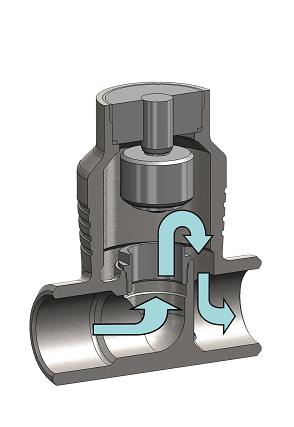
A new modular valve body design pioneered in Bürkert's latest INOX range of space saving modular valve bodies has increased the flow coefficient of a conventional angle seat valve, reducing energy requirements and improving system flow characteristics.Valve systems used in the past for conventional piping are designed so that the inlet to the valve and the outlet from the valve are at one level. Inside the valve, the fluid flow is conducted through a seat, which requires redirecting the fluid three times.
This construction inevitably causes flow losses in the valve, which negatively affect the Kv value (flow coefficient for a valve) - a factor that must be taken into account when selecting and dimensioning a valve.
In the new, modular basic body, the inlet level and outlet level are separate. Since the fluid flow now only has to be redirected once through 180Ëš, this increases the flow coefficient.
Separating the two levels also improves the design in other ways: The inlet and outlet level can now be connected directly with other valve bodies, without additional piping. The connections of the basic bodies can be assembled in a block and designed according to user-specific requirements. A pipe connection between the single valves is no longer necessary, since the fluid connection is established simply by joining the valve bodies.
The concept was developed under the premise of "mass customisation" so that it also allows the cost-effective production of customised solutions in small batches. In this case several valve bodies can be joined to form a block using orbital welding technology. The result is a strong compact block that can receive valve actuators and peripheral items direct to their own ports.
The bodies can be combined with standard Bürkert valve actuator heads, which in turn can be used together with a position indicator or positioner. In addition, it is possible to integrate sensors for measuring flow rate, temperature and pressure. This solution is extremely flexible with respect to the connecting threads and connecting technology, so that it can be adapted to the requirements of each respective application.
For more information, please contact:
Helen Christopher
Bürkert Fluid Control Systems
Fluid Control Centre
1 Bridge End
Cirencester
Gloucestershire
GL7 1QY
United Kingdom
Tel: +44 1285 648720
Fax: +44 1285 648721
Email: helen.christopher@burkert.com
Web: www.burkert.co.uk
 Print this article
Share article:
Process and Control Today are not responsible for the content of submitted or externally produced articles and images. Click here to email us about any errors or omissions contained within this article.