



SPRAY NOZZLES HELP TO KEEP THE WINE FINE
13/11/2013 BETE Ltd
Spray nozzle specialists BETE Ltd has successfully applied their XA Series of air atomising nozzles in a humidity control system for one of the World's largest wine logistics companies.The Application:
Storing wines for extended periods has traditionally been in caves or underground cellars, simply due to the fact that these environments naturally maintain a steady temperature over prolonged periods. Excessive temperature variations are more likely to occur in above ground storage facilities which could impair the wine. What is less well known is that humidity levels can also affect stored bottled wine. For example, if humidity is too high then it can seep into the cork causing bacterial contamination which could ruin the wine, whereas if humidity is too low over time, wine can be lost through the cork. Whilst wine loss will not necessarily result in it being impaired, it will result in a loss of value and a good sommelier will know if such a loss has occurred. Therefore, a constant level of humidity, as well as temperature, is required for optimum wine storage and thankfully these conditions occur naturally in caves, although to a lesser extent in cellars.
The Challenges:
Naturally occurring caves or underground cellars are a limited resource, and quite possibly located in inconvenient places. Building large purpose-built underground wine storage facilities is expensive, so the solution has been to build above-ground storage facilities to meet the growing needs for wine storage as consumption has increased. Replicating the ideal wine storage conditions found in natural caves requires careful planning and control.
Optimum temperature control using a good air conditioning system is relatively easy to achieve where sensors will detect either an increase or a drop in temperature and will activate the heating system accordingly.
A simple thermostat feedback system has some complexities when scaling up to larger warehouses, although because feedback is relatively quick and sensors are very sensitive, steady temperatures can be maintained with relative ease.
Technical Considerations:
Things become more complex though when there is a need to maintain a steady level of humidity. Natural caves or artificial underground structures maintain constant humidity because equilibrium is reached between areas of high humidity and low humidity. Water tends to move from high to low concentrations because the cave is surrounded entirely by rock or earth containing moisture, so it takes considerable time for the relative levels of moisture to change. In fact, the entire surrounding material would need to dry out significantly before moisture levels within the atmosphere of the cave begin to be affected. Whilst in very hot climates seasonal changes could feasibly affect this, in most temperate climates the changes in the moisture of the surrounding ground are sufficiently small to mean that caves simply don't change their humidity levels.
In contrast to the steady state environment of a cave is an above ground wine warehouse. The outside air humidity levels will vary considerably during a day, if it rains for example, humidity levels will jump in a matter of minutes. The air outside the warehouse is constantly being exchanged rapidly with the air inside the warehouse. The everyday fluctuations mean that changes in outside humidity will quickly affect the warehouse humidity levels. Typically, above ground warehouses will have humidity levels too low for optimum wine storage.
Adding moisture to increase humidity levels in an area can be achieved through the use of suitable spray nozzles which provide a very finely atomised spray. Very fine atomisation is required to allow for the quick evaporation of the water and for the fluid to swiftly move around the area required and air atomising nozzles are typically used to produce the desired spray. However, optimum conditions depend on how quickly humidity changes can be detected and acted upon by an automated system.
In order to maintain steady humidity levels with a fluctuating outside environment, ideally one would need a feedback system similar to a thermostat. An effective 'humidity thermostat' has two main limitations. Firstly, the feedback time between detection and correction can be long and if a drop in humidity is detected and the nozzles shut-off after the desired humidity is reached, then humidity may continue to rise after this as the fluid moves around. In smaller areas it is possible for effective humidity control with such feedback systems, but in larger areas the greater lag in response times means it is very difficult to achieve the same result.
The second problem is there is no effective way to remove moisture from a large area once it's been humidified. If the humidification system over sprays for some reason then the only way to reduce humidity is to wait for moisture to disperse naturally.
The Solution:
Over ground caves are a viable solution for wine storage but an effective humidification system needs to be installed. The problems with effective feedback on humidity levels means it's a more complex problem than temperature control - but that doesn't mean it's unsolvable. However, it does require an engineer who understands the dynamic environment in place and who can make sensible judgements about spray cycle times and how they should be varied.
As already discussed fully automated humidity control systems in large spaces are problematic so it's likely that humidity will be controlled by set spray cycles. Levels of humidity should then be monitored so the cycle times can be adjusted if necessary. Also, variations in seasonal humidity along with night and day levels need to be taken into account when setting the overall spray cycles.
There are many variables to consider so achieving a balanced humidification system is often a case of trial and error. How long this trial and error period takes depends on the level of experience of the system installer. Whilst no engineer is going to get the on/off cycles spot on first time, someone with experience of such installations will work out the correct settings faster. As with many situations it comes down to a blend of good theory and practical hands- on knowledge.
Case Study:
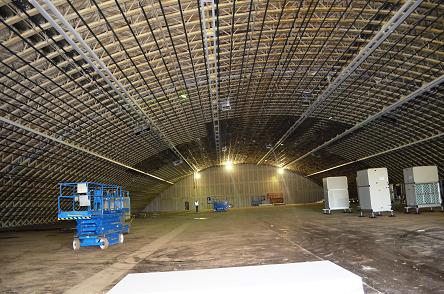
Converting an old aircraft hangar into a state-of-the-art 'underground cave'.
One of the World's largest wine logistics companies has converted old aircraft hangers into purpose-built facilities in the UK where fine wines from around the world are stored before being transferred to wine merchants throughout Europe. If this was just 'normal' wine then it would still be a considerable challenge to store it correctly, but a tour around the warehouse is like taking a tour of the world's greatest wine. For example, Chateau Lafite, Mouton Rothschild, Petrus, Vosne-Romanee are some of the fine wines stored by the pallet load of cases and some of these wines will be worth in excess of £1000 a bottle when mature. Therefore, optimum climate control is vital.
The thick concrete walls of these structures provide good thermal and humidity insulation, but with such valuable assets a high quality environmental control system is absolutely essential. Piping specialists Regent Mechanical were chosen to undertake the installation of the system utilising BETE Limited's XA series Air Atomising nozzles for the humidity control system.
A series of 16 XA PR atomisers were installed in 4 pods of 4 and because the warehouse was so large it was divided into 4 zones, each with its own climate control system. The individual zones have their own humidifying pod which is calibrated and set to deliver the correct levels of water to maintain optimum humidity levels. Extensive monitoring of humidity levels throughout the day and night needed to be undertaken to ensure that the on/off cycles were correctly set but, the final result is a warehouse with a steady temperature and humidity. The aircraft hangar has been successfully converted into a very large over ground cave.
The XA ER nozzles operate with an external mix which means the exit orifice can be larger allowing for viscous fluids to be sprayed. The XAER is also a liquid pressure fed nozzle (as opposed to siphon fed), so the flow rate is not dependent on the air pressure which results in easier control. They are available for ¼" and -…›" pipe sizes and can be specified in a choice of standard materials including nickel plated brass, 303 or 316 stainless steel.
For more information, please contact:
Ivan Zytynski,
BETE Ltd,
PO Box 2748,
Lewes,
East Sussex,
BN8 4BA, UK
Tel: +44 (0) 1273 400 092
Fax: +44 (0) 1273 401 22
Email: info@beteuk.com
Web: www.beteuk.com
 Print this article
Share article:

Process and Control Today are not responsible for the content of submitted or externally produced articles and images. Click here to email us about any errors or omissions contained within this article.