



Taylor Delivers Bespoke Food Solution in Two Weeks
14/11/2011 Egbert H. Taylor & Co Ltd
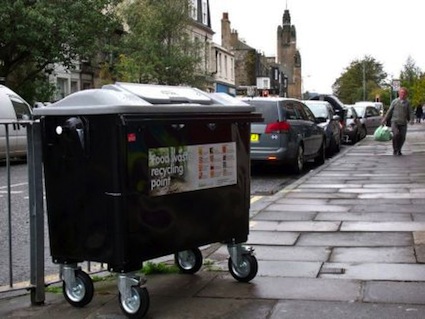
Taylor has delivered customised food collection bins to Edinburgh City Council at very short notice.Edinburgh City Council has recently launched a communal food waste collection service for residents of Portobello, a suburb on the outskirts of the city. For the initiative the council required customised containers with an aperture that would allow waste to be easily deposited without risk of cross contamination. Taylor was able to work with the council to design and produce a prototype for the trial within two weeks.
In the UK we throw away approximately a third of all the food that we buy. As society becomes more aware of its responsibility to become more sustainable and reduce landfill the idea of separate collections for food waste has risen in popularity. Food waste can easily be recycled; however, there are complications with collection that has hindered communal collection attempts in the past.
Food waste can be quite dense which means that collection containers need to be smaller in volume than many recycling points due to weight constraints; food collection bins shouldn't be any larger than 500L to prevent the risk of handles or lifting brackets snapping during collection. Food waste will also decompose rapidly which means that collection points need to protect the public from the contents of the bins. A well designed container lid and efficient collection programme is needed to allow communal waste collection to be a success.
Edinburgh City Council has launched a waste collection trial in the suburb of Portobello with hopes that the scheme will prove popular with the city's residents. The council was aware of the issues of weight and the speed of decomposing with food waste so needed to specify a bespoke solution for the project. Fortunately Taylor, Europe's leading manufacturer of metal waste containers, was able to design and build prototype bins for the trial within two weeks of being approached for a replacement.
Kevin Docherty, Area Business Manager for Taylor, comments: "I worked with the council to develop a food collection lid that features a specialised aperture that allows for food to be deposited while protecting the user from the contents of the bin. We understood that the lead time was very short, and the success of the trial depended on appropriate containers; we were able to deliver the first working prototype within two weeks."
Riet Garsed, Project Officer for Edinburgh City Council, said: "The support that we received from Taylor was superb given the time constraints that they had to work to.The swift response generated a fantastic product that more than lives up to Taylor's reputation. Since the first run of containers was delivered we haven't had a problem; and the food collection initiative is proving to be quite a success."
The lid uses a restricted aperture that is suitable for depositing small bags of food waste but won't allow larger, unsuitable waste items. The innovative design features a pull-out, hinged flap that has a shelf attached at an angle. As the flap is opened the shelf raises up to the opening ensuring that the bin remains sealed and the user does not come into contact with its contents. Once the waste is placed on the shelf the flap will close and the waste is safely deposited.
The lids are supplied with the 500L version of Taylor's flagship Continental waste containers. The ergonomically designed container uses high quality castors and handles for easy movement and lifting brackets that are rigorously tested for maximum safety. The Continental 500L container is fully EN840 accredited and conforms to the WISH guidelines for safety.
For further information, please contact Scott Bentley:
Egbert H. Taylor & Co Ltd, Oak Park, Ryelands Lane, Elmley Lovett, Droitwich, WR9 0QZ, UK Tel: +44 (0)1299 251 333 Fax: +44 (0)1299 254 142 Email: scott.bentley@taylorbins.co.uk Web: www.taylorbins.co.uk
 Print this article
Process and Control Today are not responsible for the content of submitted or externally produced articles and images. Click here to email us about any errors or omissions contained within this article.