


The hidden water bill behind compressor cooling
22/10/2026 Atlas Copco Compressors UK
Chris Ferriday, Business Line Manager for Process Cooling Solutions, Atlas Copco Compressors UK
Water-cooled compressors are valued for their efficiency and ability to manage high heat loads, but the way that heat is removed can make a dramatic difference to water use, operating cost and compliance. Chris Ferriday, Business Line Manager for Process Cooling Solutions & Process Filtration at Atlas Copco Compressors UK, explains why manufacturers should look beyond energy consumption when reviewing compressor cooling.
When manufacturers look at the efficiency of a compressed air system, electricity consumption understandably receives most of the attention because it represents by far the largest proportion of the lifetime cost of producing compressed air. For sites running water-cooled compressors, however, focusing exclusively on energy can leave another important resource largely unexamined: the water being used to remove the heat generated by the compressor.
The choice of cooling system can make a striking difference. As an illustration, a 1,000kW adiabatic cooling system may use around 500m³ of water over a year, while a comparable cooling tower can consume approximately 15,000m³ once evaporation, drift and blowdown are taken into account. The precise figures will vary according to climate, operating hours and the application, but a difference of that order brings water consumption into sharp focus, particularly as manufacturers face increasing pressure to reduce resource use and manage operating costs.
Where does all the water go?
Cooling towers remain widely used in industry because they are an effective way of removing large amounts of heat and can achieve relatively low cooling-water temperatures. Warm process water enters the tower and encounters ambient air, allowing a proportion of the water to evaporate. That evaporation removes heat from the remaining water before it is returned to the compressor or process, but it also means that water is continually being lost and must be replaced.
Evaporation is only part of the picture. As water leaves the system, minerals, salts and other impurities become more concentrated in what remains, so some of the circulating water has to be discharged as ‘blowdown’ and replaced with fresh ‘make-up’ water. Drift, leaks and maintenance losses add further consumption. Once these factors are included, the cost of operating a cooling tower extends beyond the water appearing on the utility bill to include wastewater charges, chemical treatment, monitoring and ongoing maintenance. At many UK industrial sites, water supply and discharge costs can exceed £3 to £5 per cubic metre. Over the life of an installation, the difference in water consumption between cooling technologies can therefore amount to tens of thousands of pounds.
Those treatment requirements cannot simply be scaled back to save money. Minerals can form limescale on heat-transfer surfaces, reducing the effectiveness of the cooling system and increasing the energy needed to move heat away from the process. Additionally, corrosion can shorten the life of pipework, heat exchangers, pumps and valves, while biological growth has to be controlled. A cooling system that looks economical when judged only on its initial purchase price can therefore accumulate a broader range of operating costs over its working life.
The compliance burden
Open evaporative systems also create considerations that go beyond utilities and routine maintenance. Cooling towers generate aerosols during normal operation and therefore require a structured Legionella management programme as part of the site’s health and safety responsibilities. This includes appropriate water treatment, routine monitoring and sampling, cleaning and disinfection where required, together with documented records of the measures being taken. None of this makes cooling towers inherently unsuitable, but it does add another layer of responsibility for operators and maintenance teams. For some applications, that responsibility is justified because a cooling tower provides the temperatures or heat-rejection capacity the process requires. The important point is that the decision should be made with a clear view of the total operating burden rather than on capital expenditure alone. Water purchase and discharge, chemical dosing, cleaning, sampling, maintenance and compliance all form part of the cost of keeping the system running effectively.
Use water when it adds value
A closed-loop adiabatic cooler approaches heat removal differently. For much of the year, ambient air passes across a heat exchanger containing the closed process-water circuit and removes heat without consuming water from that circuit. When outdoor temperatures increase and dry cooling alone can no longer provide the required performance, water is introduced to an adiabatic section before the air reaches the heat exchanger, reducing the temperature of the incoming air through evaporation.
This means water becomes a way of boosting cooling performance during hotter periods rather than the mechanism on which the system depends continuously. Once ambient conditions fall again, the cooler can return to dry operation. For a manufacturer, that distinction can translate into a substantial reduction in annual water use, particularly in climates where the system can spend much of the year operating without adiabatic assistance. With water increasingly recognised as a critical resource alongside energy, reducing water consumption can contribute directly to corporate sustainability targets as well as representing an operating-cost reduction.
Keeping the process water within a closed circuit brings additional benefits. The cooling water is not continually exposed to outside air, so there is no continuous process-water evaporation or blowdown and far less opportunity for contamination to enter the circuit. Depending on the system design, this can greatly reduce the water-treatment requirement and remove much of the routine management associated with an open evaporative cooling tower.
There is, of course, no cooling technology without trade-offs. Adiabatic coolers generally require more airflow when operating dry, so fan energy can be higher than that of a cooling tower under certain conditions. The appropriate comparison therefore needs to consider annual energy use alongside water consumption, operating hours, required cooling-water temperature and local ambient conditions, rather than selecting whichever technology performs best against one isolated measure.
Looking beyond first cost
This broader view becomes particularly important when manufacturers replace an existing cooling system or specify cooling for new compressor capacity. In practice, cooling equipment can represent a relatively small proportion of the overall compressor project, which means the choice is sometimes driven primarily by capital expenditure. Yet the operating costs associated with water use, treatment and compliance can exceed the initial purchase-cost difference between technologies over the life of the system. A cooling tower may therefore present an attractive initial capital cost, while revealing relatively little about what the system will cost to own over the next ten or fifteen years.
By comparison, closed-loop adiabatic systems will typically require a higher level of initial investment, but their lower water use can reduce many of those recurring costs. The benefit is not simply a lower water bill. Using less water can also mean less treatment, less wastewater, fewer chemicals and a simpler maintenance regime involving less manpower, while reducing exposure to the operational demands associated with an open evaporative circuit. For sites where water availability or cost is already becoming an issue, these factors can carry increasing weight in an investment decision.
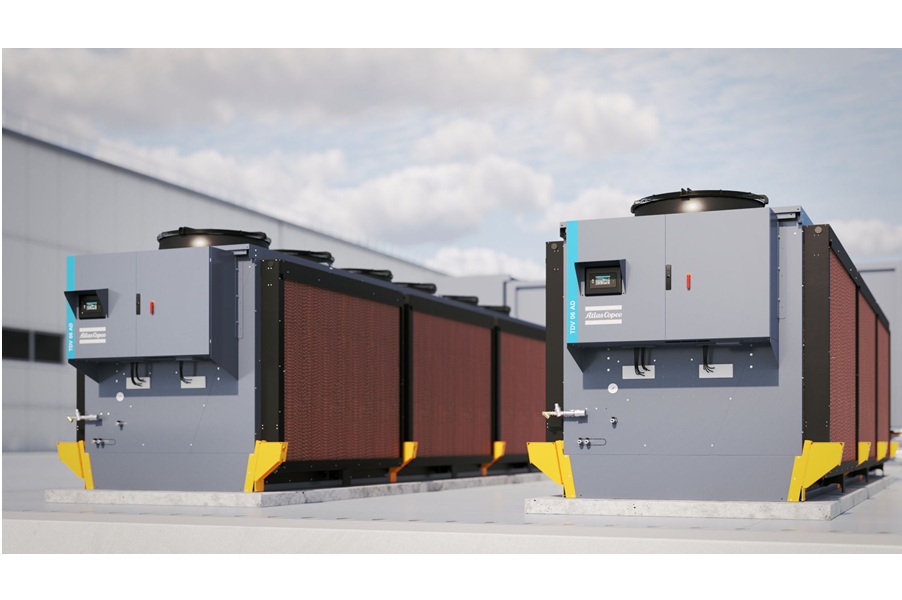
This is the principle behind equipment such as Atlas Copco's TDV industrial fluid cooler, which can be used with water-cooled compressors and other industrial process equipment. In an adiabatic configuration, ambient air provides the primary means of heat removal, while humidified pads reduce the inlet-air temperature when additional cooling is required. The compressor cooling water remains contained within the closed circuit rather than being consumed as part of the heat-rejection process.
The wider lesson is more important than any individual product. Cooling should be considered as part of the compressed air system rather than an ancillary decision made once the compressor has been selected. Required water temperature and heat load are clearly central to the specification, but manufacturers should also consider local climate, operating hours, available space, water availability, wastewater costs and the maintenance resources needed to operate the system over its lifetime.
Compressed air users have become accustomed to questioning unnecessary energy consumption, whether that means finding leaks, improving controls or making sure compressors are correctly matched to demand. There is a strong case for applying the same discipline to cooling water. Where two technically suitable approaches can differ by thousands of cubic metres of annual water consumption, the choice of cooling system has implications well beyond the compressor room.
Rather than asking simply how effectively the compressor can be cooled, manufacturers should be asking what resources are required to achieve it and what those resources will cost over the life of the installation. For many water-cooled compressor applications, that makes the case for closed-loop adiabatic cooling as much about operational efficiency as environmental performance.
To find out more about Atlas Copco's industrial cooling solutions, including closed-loop adiabatic cooling for water-cooled compressors, visit https://www.atlascopco.com/en-uk/compressors/process-chillers
 Print this article
For more information, please contact:
Atlas Copco Compressors UK
Technology House
Hemel Hempstead Industrial Estate
Maylands Avenue
Hemel Hempstead
Hertfordshire
HP2 7DF
Tel: +44 (0)1442 261201
Email: compressorsGB.web@atlascopco.com
Web: https://www.atlascopco.com/en-uk/compressors
Share article:
Process and Control Today are not responsible for the content of submitted or externally produced articles and images. Click here to email us about any errors or omissions contained within this article.