


The Recipe for Long Term Manufacturing Success A Field Guide to Building Companies That Last
14/08/2026 Finish Thompson Inc.
Longevity in manufacturing is rarely accidental. Companies that endure across decades – through economic cycles, technology shifts, ownership changes, and evolving customer expectations – tend to follow a consistent set of principles, whether or not they articulate them formally. Companies like Finish Thompson, a privately held manufacturer celebrating 75 years of operation, demonstrate how these principles play out over time in the real world.
Manufacturing history is full of technically capable organizations that failed because they optimized for the wrong things at the wrong time: short term margin over long term value, expansion over resilience, or growth without cultural alignment. By contrast, manufacturers that survive multiple industrial eras tend to treat longevity itself as a design constraint. Every strategic choice is filtered through a simple question: Will this help the company still be healthy ten, twenty, or fifty years from now?
Think of the following as a practical “recipe” for long term manufacturing success. This is not a checklist, but a set of interconnected practices that reinforce one another over time. While these lessons are informed by decades of real-world experience, they are applicable to manufacturers of any size, in any market, and at any stage of maturity.
Step One: Design for Change Before You Need It
Most manufacturing failures are not caused by sudden disruption. Often, they result from slow misalignment, with companies reacting too late to shifts that were long visible. Long term success requires a willingness to look ahead, even when the immediate need is not obvious. This starts with cultivating a mindset of preparedness rather than reactivity.
No organization has a reliable crystal ball, but manufacturers can continuously ask whether they are operating in the best way possible today. When improvement is treated as a constant rather than a response to crisis, organizations tend to stay ahead of market shifts almost by default.
Critically, this approach reframes change as an internal responsibility rather than an external threat. The most resilient manufacturers view themselves as their own primary competitors. If processes, structures, or assumptions go unchallenged for too long, the organization becomes vulnerable, regardless of what competitors are doing.
Step Two: Let the Market Guide You, but Listen Actively
Rather than trying to force markets in a particular direction, long-term manufacturing success comes from listening carefully and responding decisively.
This requires close, sustained contact with customers not just at the purchasing level, but at the application level where real problems emerge.
Sales and marketing teams play a critical role here, not as transaction drivers, but as sensors. When they maintain deep relationships and stay embedded in the field, they can surface emerging needs early enough for engineering and operations to respond thoughtfully rather than reactively.
Innovation, in this context, is not about novelty for its own sake. It is about solving practical problems that come up in better ways. Manufacturers that anchor innovation at the employee feedback level tend to evolve naturally over time, expanding capabilities in directions the market already values.
Step Three: Build Stability That Enables Evolution
A common misconception in manufacturing leadership is that stability and evolution sit at opposing poles. In practice, stability is often what makes meaningful evolution possible. Finish Thompson’s 75-year history underscores how disciplined operations and reliable quality create the stability required to add new capabilities without destabilizing the underlying business.
This balance requires restraint. Instead of constantly chasing the next product opportunity, long-term manufacturers focus on making existing offerings as strong as possible before expanding the portfolio. New products are introduced not to chase growth, but to extend the company’s ability to serve customers more completely.
Over time, this approach creates a virtuous cycle: strong core products generate trust, trust enables customer feedback, feedback informs innovation, and innovation reinforces long-term relevance.
Step Four: Use Vertical Integration Strategically
Vertical integration is not a goal in itself. It is a tool that can significantly enhance agility and quality when applied deliberately. For manufacturers navigating increasingly consolidated supply chains and distributor networks, bringing critical capabilities in-house can reduce lead times, improve consistency, and increase responsiveness.
The signal that vertical integration makes sense is usually external pressure combined with internal readiness. When customers demand faster delivery, tighter quality control, or greater flexibility, and when reliance on external partners limits the ability to respond, integration becomes a strategic advantage. Done well, it allows manufacturers to control what matters most without sacrificing focus. Done poorly, it can add complexity without value. Long term success depends on knowing the difference.
Step Five: Treat Culture as Infrastructure
Culture is often described as a “soft” advantage, but in manufacturing, it functions more like infrastructure. It determines how information flows, how decisions are challenged, and how quickly organizations adapt under pressure.
Companies that last tend to practice a form of servant leadership, where leadership exists to support the organization, not the other way around. Leaders who view themselves as temporary caretakers of a company, rather than beneficiaries of it, make different choices. This mindset prioritizes financial discipline, including maintaining low debt levels to preserve flexibility during downturns. It also emphasizes customer satisfaction over short-term profitability, trusting that financial performance will follow when value is delivered consistently. Manufacturers that last are not built around quarterly outcomes – they are built around continuity.
In these environments, employees are encouraged to raise ideas, question processes, and improve their own workspaces. Feedback is not a formal exercise; it is part of daily operations. This kind of culture produces tangible outcomes: longer employee tenure, deeper institutional knowledge, and better execution of complex strategies. When people feel invested in the company’s success, they behave like stewards rather than participants.
Manufacturers with multi-decade horizons also tend to hire and develop people differently. Instead of optimizing for immediate role fit, they look for individuals who align with the company’s values and long-term goals. Career paths should be built internally, with opportunities for advancement based on contribution rather than credentials alone.
Profit-sharing, internal promotion, and visible leadership accessibility reinforce this approach. Over time, these practices create leadership teams with deep, ground level understanding of the business. They produce leaders who have seen the organization from multiple perspectives and can make better decisions as a result.
How These Principles Come Together in Practice
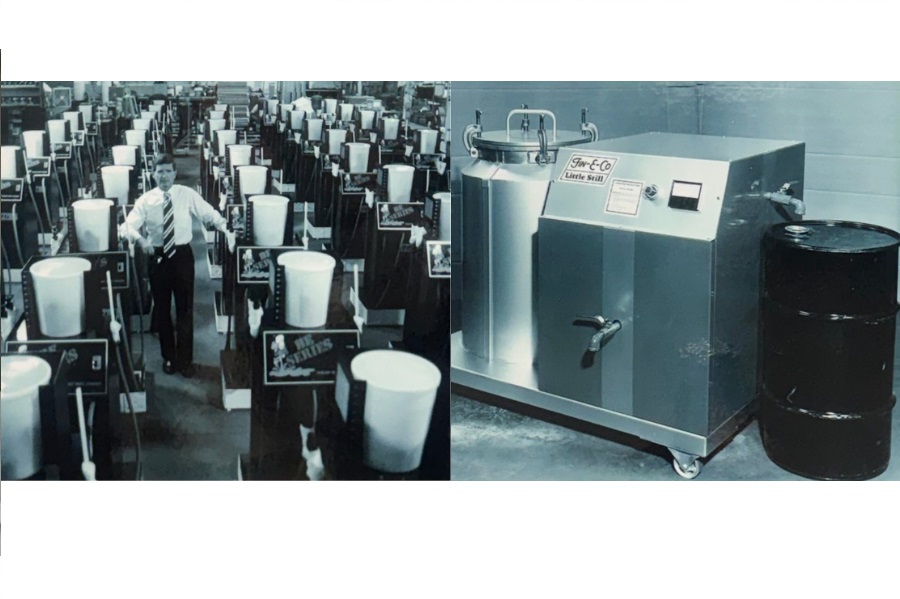
These practices are not theoretical. They are lived daily by manufacturers that have successfully navigated multiple industrial transformations. At Finish Thompson, long term thinking has guided everything from market transitions to organizational structure. The company’s evolution—from finishing equipment to solvent distillation to pump manufacturing—was driven not by speculation, but by close attention to customer needs and internal capabilities.
Vertical integration has enabled agility and quality control in a consolidating distribution landscape. A culture of servant leadership and open communication has supported continuous improvement from the shop floor up through executive leadership. Internal promotion and profit-sharing have fostered long employee tenure and deep institutional knowledge. Throughout each transition, decisions have been filtered through a long-term lens: serve the customer well, take care of the team, and preserve the company for the next generation.
This approach has allowed Finish Thompson not only to adapt, but to do so without losing its identity, demonstrating that long term manufacturing success is less about following trends and more about committing to principles that hold up over time.
 Print this article
For more information, please contact:
Finish Thompson Inc.
921 Greengarden Road
Erie, PA 16501
USA
Tel: +1 (800) 934-9384
Web: https://www.finishthompson.com/
Share article:
Process and Control Today are not responsible for the content of submitted or externally produced articles and images. Click here to email us about any errors or omissions contained within this article.