



The shift from supplier to full-service partnerships in manufacturing
02/05/2025 Rubix
Amir Wagenstein, Group Supply Chain & Logistics VP at Rubix, explores how the role of manufacturing suppliers is evolving to strengthen performance and the bottom line.
Global competition, shifting customer requirements and sweeping changes in the political landscape are just some of the factors that are changing the face of manufacturing today. Against this backdrop, manufacturers need to manage their costs, deliver consistently high levels of quality and improve their agility in order to quickly adapt to market demands.
This challenging landscape is enough to overwhelm even the most experienced manufacturing businesses, prompting an evolution in supplier relationships.
Gone are the days of straightforward transactional relationships, as manufacturers move in favour of dynamic partnerships that see greater levels of integration and value-added services that elevate performance and, ultimately, the bottom line.
How is manufacturing changing?
Manufacturers are no longer just seeking components from their suppliers. In a world where every second counts and every penny matters, suppliers are increasingly being relied on to support broader efforts to maximise efficiency, productivity and profitability.
It is no secret that unplanned downtime is one of the biggest costs for manufacturers. When machines aren’t running as they should, production grinds to a halt, customer deadlines get tighter and, often, more resource is required to deliver on time. All of this adds greater levels of cost to a business, squeezing margins, reducing profitability and even compromising long-term stability.
To reduce levels of unforeseen downtime, a key requirement is to have the right components on hand exactly when they are required. In practice, when a machine requires attention, the parts needed are on hand. Day-to-day, this can ensure operations continue to run smoothly as operators have all the tools and components they need.
Achieving this position requires a complete understanding of the business and its critical operations. Being able to anticipate which parts will be required most frequently, how many components are needed, and how to efficiently store them is a complex undertaking – but it’s one where suppliers’ expertise can be most valuable.
Inventory on demand
Traditionally, keeping adequate levels of spare components on site has led to severe inefficiencies for manufacturers. Firstly, purchasing components long before they’re needed requires up-front investment – only for that resource to sit unused for several weeks, months or even years. On top of this, monitoring levels of consumption and maintaining effective inventory management have led to parts going unnoticed and unused.
This has a tangible impact on the bottom line for manufacturers. Investing in components ahead of time, using valuable space to store them, and needing to invest in further technology to accurately maintain inventory translates into significant costs. Against global competition, these finances could have a greater impact elsewhere in the business, avoiding the need to tie up cash in components which sit in a warehouse for prolonged periods.
These processes are further complicated when multiple suppliers are used. As well as creating greater complexities within the supply chain, the use of several suppliers can limit the level of knowledge and insight each holds on a business and keep relationships as purely transactional.
By consolidating the supply chain and changing this traditional approach to inventory management, innovative vending solutions are able to play an active role within manufacturing businesses, helping to keep essential components on hand, accurately track the use of consumables and save businesses money.
Consolidating supply through partnerships
As Europe’s largest supplier of industrial maintenance, repair and overhaul products and services, Rubix and its team of specialists have a wealth of expertise that can transform inventory management for manufacturers.
Having partnered with some of Europe’s busiest and most demanding manufacturers, Rubix has seen what it takes to keep things running smoothly – and has been a critical part of the process. As a result, the business has developed three inventory management solutions that can be adopted by businesses to improve their operations.
With each tailored to the specific requirements of a manufacturing business, these inventory management solutions provide a cost-effective way to stay in control by leaning on the expertise of a supply partner.
Supporting manufacturing businesses to achieve greater purchasing efficiency, maintain lower inventory and replenishment costs and keep productivity on track, InscanTM is an accessible inventory solution for manufacturers of all sizes.
Based on barcode scanning technology provided by Rubix, the system allows the ongoing monitoring and replenishment of stock. In practice, when critical equipment is running low, stock is topped up to ensure availability around the clock – whether that’s at a central location or individual manufacturing sites.
On top of this, the technology harnesses valuable data through the usage of consumables. This means comprehensive reporting can track key data for the business, enhancing understanding of operations and potentially identifying areas for improvement.
On-site inventory management expertise
For manufacturing businesses with high consumption of critical parts, holding stock on-site is the only way to guarantee availability exactly when it’s required. Done correctly, this can elevate efficiency and ensure cost efficiency.
InvendTM – an industrial vending solution from Rubix – ensures critical parts are available 24/7, giving the team access to critical equipment whenever it’s needed.
To understand what components need to be stocked, Rubix’s team work to understand the nature of the business and identify the most frequently used products. With vending machines installed within the manufacturing facility, and scaled to the specific size and requirements of the plant, InvendTM delivers complete reliability in the supply of critical components.
In practice, on-site vending solutions optimise inventory management, cutting the number of orders being placed to suppliers, improving usage monitoring and even reducing the amount of equipment by up to 40%. As each vending machine stocks the most in-demand components, manufacturers can also free up space on site and avoid the potential for stockpiling – potentially freeing up finances that may be better applied elsewhere in the business.
For the largest manufacturers, however, a solution beyond on-site vending is required to streamline operations and deliver cost efficiency. Here, nothing short of a personalised, on-site brand of Rubix will do.
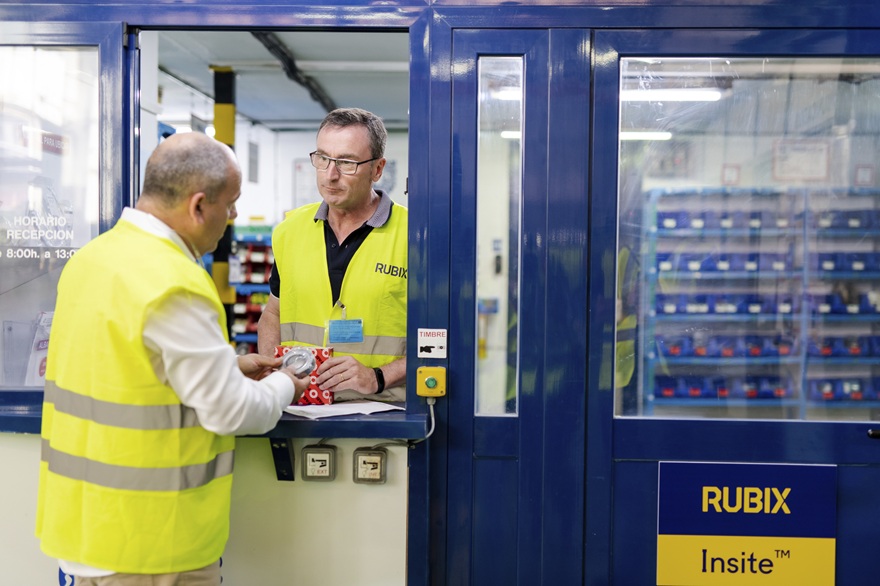
Our experience tells us that supplier consolidation is one of the single greatest factors in reducing the cost of inventory. And strategically, there is no stronger solution than having sole access to a personalised suite of inventory managed by Europe’s leading supplier. This is what InsiteTM delivers for manufacturers.
Staffed to suit the specific needs and shift patterns of a manufacturing plant, InsiteTM ensures specialist support and full product availability are always on hand. Whether that’s the expertise of a dedicated manager to identify the correct component, provide technical advice to overcome a specific challenge, or deliver dedicated, hands-on help to keep every critical component stocked, InsiteTM provides a seamless, fully tailored solution to inventory management.
A flexible, digital-first solution
Bridging the gap between Inscan™ and Invend™, Rubix’s Kiosk solution delivers a streamlined, digital-first approach to inventory management – without the need for a physical vending machine.
Combining the convenience of automated inventory tracking with the flexibility of a traditional storeroom, the Kiosk solution provides manufacturers with access to a pre-approved range of products via a touchscreen Automated Transaction Request (ATR) terminal. Operated using a secure PIN, swipe or proximity card, the system allows authorised users to collect components 24/7 while capturing detailed consumption data.
The plug-and-play nature of the Kiosk means it can be deployed quickly and scaled to suit operational needs. It’s particularly well-suited for items too large or varied to be stocked in a standard vending machine, while maintaining the benefits of real-time visibility and control over usage.
Restocking is based on agreed minimum and maximum levels, ensuring stock is replenished automatically in line with demand – helping businesses reduce costs, avoid overconsumption and keep production flowing.
Preparing for the future of manufacturing
For manufacturing businesses operating today, there is greater uncertainty than ever before. By redefining inventory management and sourcing a solution that works for your business, it is possible to strengthen operations, boost productivity and cost certainty, and even elevate competitiveness on the world stage.
The key to achieving this is to lean into the expertise of your supply partner. As Europe’s leading supplier of MRO products and services, Rubix is perfectly positioned to help you navigate the complexities of modern manufacturing through innovative solutions designed around your needs.
Take your business to the next level with Rubix: www.rubix.com.
 Print this article
For more information, please contact:
Rubix
Web: https://www.rubix.com
Share article:
Process and Control Today are not responsible for the content of submitted or externally produced articles and images. Click here to email us about any errors or omissions contained within this article.