



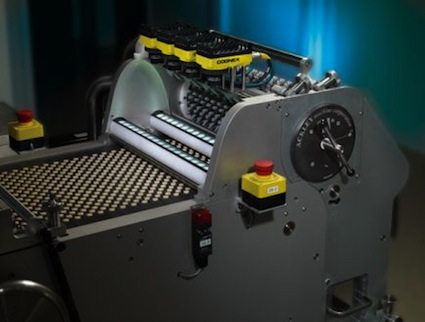
Vision system enables fast and inexpensive upgrading of tablet printing systems
27/09/2011 Cognex Germany Inc.
Ackley Machine Corporation, a global leader in tablet, caplet, capsule (hard and soft), and candy printing technology based in Morristown, NJ, USA was confronted with a serious challenge to its tablet printing business. Ackley Machine needed to be able to inspect all printed products in order to identify and reject bad items to comply with the US Food and Drug Administration's (FDA) mandate that each printed tablet be identifiable. The company's existing technology was not suitable for meeting this requirement. It was using cameras to acquire and a single personal computer (PC) to process images on its tablet printing machines, a process that too often bogged down. When their computer required an upgrade to its Microsoft® Windows® operating system, the validation process required for the new operating system would be too long and too costly. Ackley needed a better solution.Ackley solved this problem by switching to Cognex In-Sight® vision systems, a solution that incorporates both camera and image processing in a single enclosure. "Switching to a new vision system now requires only a short and simple validation procedure that ensures the new vision system provides the same functionality as the old one," said Mark Ford, Engineering Manager for Ackley Machine. "The In-Sight vision system also is much easier to program because its PatMax® pattern matching algorithm easily finds the printed image on the tablet with a single command." Ackley deployed this solution in its latest system, which prints and inspects over 400,000 tablets per hour, much faster than other machines, while providing unique single tablet rejection capabilities.
Need for drug identification
Since 1975, the FDA has required that all prescription tablets or capsules have a unique identification in terms of size, shape, colour and imprint. Drug manufacturers use the imprints both to identify the chemical substance and dosage and for product marketing purposes. Acceptable identification has traditionally been achieved by debossing-€â€pushing the image below the level of the product, embossing-€â€pushing the image above the level of the paper, or printing. Coating systems used in the manufacturing process today tend to fill in debossed or embossed areas, sometimes rendering them unidentifiable to the human eye especially among people with imperfect eyesight. Drug manufacturers are relying more on printing because it provides contrast, excellent compatibility with modern coatings, and a unique and attractive multicolour identification that can set the product apart from competitors and virtually eliminate counterfeiting.
The popularity of printing has created the need to inspect printed tablets to ensure the integrity of the identification. Printing is normally accomplished by using a hard roll that is engraved with the image to be printed. The hard roll contacts the ink, then a wiper removes all of the ink except for the engraved area. The ink is then transferred to a soft roll that contacts the tablet or capsule. Inspection of the finished process is critical because if the wrong ink formulation is used the ink might not adhere to the tablet, or the coating might flake off and contaminate the ink to the point that the printing becomes indistinct. Manual inspection can only handle a small sample of product. Since Ackley prints hundreds of thousands of tablets per hour, manufacturers to need a new way to ensure compliance with the FDA product identification regulations.
Ackley's original solution used a vision system consisting of a camera, an image processing card, and image processing software running on a single PC. The company was about to ship a system to a customer when the computer failed and had to be replaced. When Ackley learned they could not acquire the older version of Windows that ran their vision system, they were confronted with the task of having to validate the new software, hardware, and operating system to meet FDA requirements, a process they believed would take too long and be too expensive. "We said, wait a minute, we don't want to have this problem again," Ford said. "So we looked for a vision system that was self-contained so that it could easily be validated based on its functionality alone."
Vision systems offer easy validation
Ackley discovered that Cognex In-Sight vision systems provide a camera and image processing hardware and software within an enclosure that protects them from the factory environment. In-Sight vision systems are well suited to often-crowded pharmaceutical processing stations because they fit into a small 109.1 x 61.4 x 35.5 mm package. This approach makes it possible to write a short and simple validation procedure. So upgrading to a new model of vision system becomes a relatively simple procedure. The new approach also provides substantially higher performance when multiple vision systems are used because each vision system processes its own images.
Ackley's latest tablet printing machines use Cognex In-Sight vision systems to provide industry-leading speed and the unique ability to avoid even a single reject tablet. After printing the tablets, the machines drop them into the pockets of a carrier bar that holds up to 24 tablets. The carrier bar moves under an array of four Cognex In-Sight vision systems where each camera inspects six tablets. The vision system program first uses a histogram tool to check for the presence of the light-coloured tablet against the dark background of the carrier bar. If a tablet is present, then the vision system performs a print quality check.
Inspecting printing quality
The PatMax pattern recognition algorithm looks for the printed image regardless of its location in the image acquired by the camera. This eliminates the need for precision positioning of the camera or tablet. PatMax identifies and isolates the key individual features within an object image and measures characteristics such as shape, dimensions, angle, arcs, and shading. It then correlates the spatial relationships between the key features of the trained image to the run-time image, encompassing both distance and relative angle. By analyzing the geometric information from both the features and spatial relationships, PatMax is able to precisely and repeatedly determine the object's position without regard to the object's angle, size, or appearance.
The system is initially trained with an image of a good quality printed tablet. Operators can train the system to recognize new printing without any programming. The PatMax algorithm compares the good image to the most recently acquired image and rates the quality of the recently acquired image based on the match. The quality rating required to meet internal or customer requirements can easily be adjusted. The PatMax algorithm also returns the location of the centre of the printing on the product that was inspected. This information is used to determine how well the logo is centred on the tablet. The blob tool built into the system is used to find the centre of the tablet and the distance tool is used to measure the distance from the centre of the printing to the centre of the tablet.
Inspecting for tablet damage
The In-Sight vision system also checks to see if a tablet is broken. A broken tablet shows up as several light coloured sections against a dark background. The blob tool identifies damaged tablets by looking for light coloured blobs smaller than the tablet. In the final step, the In-Sight vision system looks for a coating defect which can be identified as a smaller white spot, because the core of the tablet is white. The blob tool is used to search for white spots. The camera acquires the image, performs each of these inspections, and builds a binary word that contains the inspection results for each of the six tablets in its field of view. The vision system sends the results to the programmable logic controller (PLC) that runs the machine. The vision system also sends each inspection image to the corporate network where it can be called up by the machine operators or engineers.
The PLC then operates a vacuum system that picks up the tablets from the carrier bar and moves them to a discharge chute. Based on the signal from the PLC, specific positions on the vacuum shoe are operated individually to either pick up or leave behind individual tablets. The tablets that have passed the inspection are picked-up and placed in the discharge chute, while those that have failed remain in the carrier bar. In the next step the tablets remaining in the carrier bar are dumped into a reject bin. This approach makes it possible to eliminate in a positive manner individual tablets that fail inspection and ensure that only good tablets are passed along for packaging.
"In-Sight vision systems operate much faster than the modular cameras used in the past, enabling the machine to print and inspect over 400,000 tablets per hour, substantially faster than any other tablet printing and inspection machine," Ford concluded. "The machine also offers a higher level of quality because it is able to reject individual tablets while other machines on the market can only reject batches of tablets which is wasteful if there is only one bad tablet in a batch."
For details, visit Cognex on-line at http://www.cognex.com
 Print this article
Share article:
Process and Control Today are not responsible for the content of submitted or externally produced articles and images. Click here to email us about any errors or omissions contained within this article.