



Young chemists inspired by energy from waste
31/08/2016 Viridor Ltd
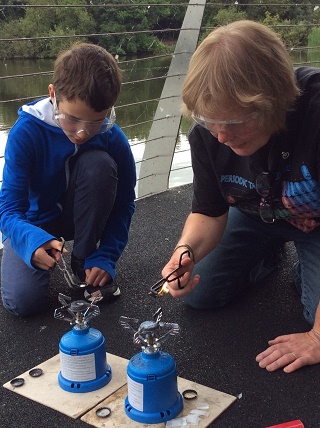
Summer holidays often pose a challenge for parents and grandparents looking to fill the long weeks until the schools go back (or the children take a break from Pokémon GO). Last week, Colnbrook's Lakeside Energy from Waste facility opened its doors to the Royal Society of Chemistry, to help local youngsters explore how chemistry is woven into the everyday process of generating electricity to keep the lights on in our homes.Rolling up their sleeves for a series of practical activities, the budding scientists discovered how ordinary garden grass clippings can quickly create biogas, with explosive consequences! Next on show was looking at how different types of plastics behaved when they were heated up. If they melted they could be reshaped - and recycled - if they just became brittle they could not be reused. The after lunch activity saw magnetism brought to life with steel and aluminium drinks cans and iron filings.
The final activity for the day was a tour around the state of the art energy from waste facility, which opened in 2010. Here, 430,000 tonnes a year of non recyclable rubbish - some of it from Colnbrook and Slough - is turned into vital renewable energy. The excited visitors were able to see for themselves exactly what happens to the waste in their non recyclable bins - as they peered through a glass panel looking down on a bunker filled with hundreds of tonnes of waste. The explorers then saw two giant grabs lift five tonnes of waste each in to the air, before it was dropped in to the beginning of the energy recovery process - where it would eventually generate enough energy to power around 56,000 homes.
Danny Coulston, Director of Operations for Lakeside Energy from Waste was also excited by the visit.
"Every day we all use electricity to watch television, make dinner or boil the kettle - as well as powering those pesky Pokémons! At Lakeside we use thrown out, unrecyclable waste to generate clean energy. Being able to show the next generation of engineers the importance of managing resources sustainably is vitally important. Working in partnership with the Royal Society of Chemistry meant our young visitors could get hands on with simple experiments - and then see them in practice inside our facility."
Jane Essex, of the Chiltern & Middlesex Branch of the Royal Society of Chemistry adds:
"We all learn in different ways. Some like using text books, while others prefer to be practically involved with the real world applications for the subjects they are studying. The Lakeside Energy from Waste facility showcases a wide range of scientific principles in an awe inspiring setting. Offering a combination of practical experiments with visits to the facility will hopefully inspire more students to study science, technology, engineering and mathematics (STEM) at school - and become the scientists of the future.
"This was a pilot exercise and we hope to work with Lakeside to develop an ongoing programme to introduce people of all ages to what goes on at this fascinating site".
Tony and Jane Mitchelmore were looking for something interesting to do with their teenage grandson Ethan - and as they are both chemists themselves, the Lakeside option seemed ideal. Tony said,
"This has been an entertaining, informative and practical demonstration of everyday science. It was clear that the young people thoroughly enjoyed their time at Lakeside - and welcomed the challenges of relating the concepts they are taught at school to what is happening in the big wide world".
For more information, please visit: www.lakesideefw.co.uk/
 Print this article
Share article:
Process and Control Today are not responsible for the content of submitted or externally produced articles and images. Click here to email us about any errors or omissions contained within this article.