



Powder dispersion with high-shear vacuum expansion
01/12/2025 ystral gmbh maschinenbau + processtechnik
If yoghurt tastes better, paints coat better or adhesives stick better, these completely different products have precisely one thing in common: the powders contained therein were dispersed better and thus develop a much more intense effect in the end product. All these products contain powders. And the quality of the end products is always crucially influenced by how well or badly these powders are opened up, mixed in and above all, dispersed.
In order to achieve the best possible result, the microscopically tiny powder particles, which all collide still in a dry powder, touch each other and partially adhere to one another, must all be separated. Every single particle must be separately surrounded by liquid, and all must be homogeneously dispersed across the entire liquid. Controlled distances are created between the particles that have just been touching each other. They are completely covered with liquid and stably kept at a distance.
 Dispersing – the core process in production
The dispersion of powders in liquids is often regarded as the core process in production. It is a complex and often problematic task. It is not possible through simple mixing in of the powders. And this is precisely where the importance of powder dispersion for future developments comes into play. Only through optimum dispersing, i. e.
- Separation
- Deagglomeration
- Complete wetting
- Homogeneous distribution and
- Stabilisation
of each individual particle, the maximum utilisation and maximum effect of the powder properties in the end product are achieved. The order of each individual step is crucial.
Traditional vs. future-oriented technologies
The difference between traditional and future-oriented technologies already becomes clear in the order of the list. Traditionally, powders were never separated first, but were always added to the liquid as a compact powder mass. The powder particles were in close contact with each other. The tight spaces between the particles were filled with air, and this air prevented liquid from getting in. Therefore, when inducting the compact powders into the liquid, not every single particle could be reached with the liquid.
This method always resulted in agglomerates to start with, which then had to be broken down again through post-processing with shear forces. Post-processing was an additional process step, which not only cost time and energy, but reduced the quality of the end product in many cases. The long shear stress required for breaking down the agglomerates usually not only heats up the product too much, it also breaks down the polymer structures and viscosity again that had been built by thickening agents and stabilisers.
The Conti-TDS technology from the German mixing and dispersing technology specialist ystral uses a completely new method. If follows the above order precisely, by first of all separating the particles and then fully wetting, deagglomerating and dispersing them. This makes this technology the most effective one for the processing of powders in liquids. The importance of this technology and its potential effect on future developments and innovations becomes very clear.
 Almost all powders must be dispersed in liquids
There are well over a hundred thousand different powder types, but in actual fact, only very few are consumed or used as a powder in the end. Almost all powders are dispersed in liquids at some point when being processed. And all powders have different properties. There are powders that completely repel the liquid. Others react with the liquid or dissolve. The powders always change the properties of the liquid. And these powders rarely form a stable dispersion without further measures.
Despite the same technology always being used, this results in numerous different methods for powder induction. The dispersion technology must respond to all these different requirements with different tool versions, shear rates and rotation speeds. And these requirements are permanently changing. Accordingly, the machine design is modular and flexible.
The know-how of ystral is not only reflected in the design of machines and systems, but also in the entire process configuration – from task analysis and optimisation up to integration into existing or new product environments to be designed. Amongst others, this includes selection of suitable dispersing processes, definition of optimum process parameters, prevention of dust formation and agglomerates, as well as targeted control of product quality and process reliability. Furthermore, the know-how comprises in-depth knowledge of thousands of different powders and their application in all areas of process engineering, the scale-up from trials to production process, automation, product development, process reliability and quality assurance.
Learn more in the whitepaper
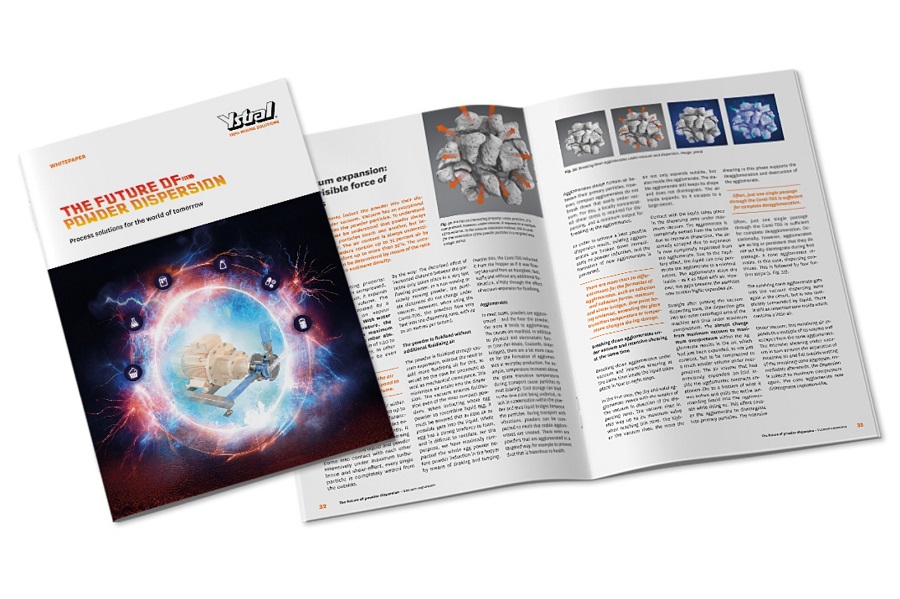
ystral’s new 40-page whitepaper “The future of powder dispersion” introduces you to the fascinating world of the dispersion of powders into liquids. It intends to outline the challenges in powder processing, and to demonstrate the universal possibilities that the Conti-TDS technology has to offer. And it wishes to present you with ideas of how these technologies can be effectively used in your industry.
 Print this article
For more information, please contact:
Thibault Weinert
ystral gmbh maschinenbau + processtechnik
Wettelbrunner Strasse 7
Ballrechten-Dottingen
Landkreis Breisgau-Hochschwarzwald
79282
Germany
Tel: 0049 7634 5603 900
Email: ystral@ystral.com
Web: https://ystral.com
Share article:

Process and Control Today are not responsible for the content of submitted or externally produced articles and images. Click here to email us about any errors or omissions contained within this article.