


Producing carbon-neutral e-kerosene with the help of a HAUG compressor
07/06/2022 Sauer Compressors
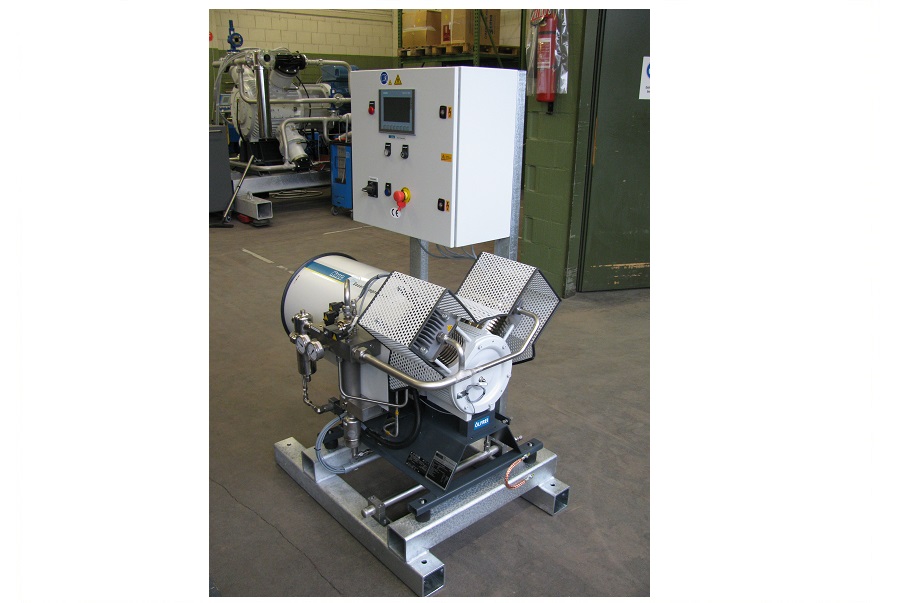
The German non-profit organisation Atmosfair has opened the world's first plant for the industrial production of carbon-neutral e-kerosene. The aviation fuel is produced using renewable energies as well as CO2 and H2. An important component of the pilot plant is Sauer Compressors' HAUG.Neptune CO2 compressor. The oil-free and hermetically gas-tight machine compresses atmospheric CO2 to be used as raw material for the green kerosene.
Carbon-neutral flying – the air transport industry's dream to make the business flourish again despite forthcoming restrictions regarding CO2 emissions. According to the current state of technology, this only works on a large scale with e-kerosene, which is produced from renewable electricity. The so-called Power-to-Liquid fuels (PtL), a liquid combination of electrically generated H2 and CO2, are to be added to conventional kerosene. That's how the German government envisions it according to their PtL roadmap. However, PtL is currently still considered too expensive for widespread use.
The non-profit organisation Atmosfair is mainly known for offering offsets for greenhouse gases. Since 2021, the company has also been producing synthetic e-kerosene with a plant in Werlte, North Germany. The special feature of the pilot plant is that it produces the first carbon-neutral PtL kerosene ever! Dietrich Brockhagen, founder and CEO of Atmosfair, explains: "As long as airplanes use kerosene, no matter if from fossil or renewable resources, they cause emissions. But for our production process we use CO2 either from a biogas plant or directly extracted from the air. Thus, when the CO2 eventually gets back into the atmosphere while the kerosene is burned, the carbon footprint is offset." With a capacity of 350 tons of synthetic crude oil per year, the operation by far exceeds the bench scale. It is the first plant worldwide producing crude oil for e-kerosene approved by ASTM International for commercial aviation. The crude oil is added to fossil fuels in a refinery and distributed to several airlines with a balance sheet certificate (TÜV seal of approval).
Electricity, hydrogen and CO2 as raw materials
The PtL plant uses the three main raw materials electricity, H2 and CO2. The electricity comes exclusively from renewable resources without funding from the German Renewable Energy Sources Act (EEG). The hydrogen is produced from water by electrolysis using electrical energy. A proton exchange membrane (PEM) acts as the electrolyser and electrochemically splits water into hydrogen (H2) and oxygen (O2).
One source of the CO2 needed for the process is an on-site biogas plant. As the substrates used by the plant only contain carbon dioxide that they have previously extracted from the atmosphere during growth phase, the operation would already be climate-neutral only by releasing the CO2. By reusing the waste CO2, the synthetic crude oil of the PtL plant is even achieving negative CO2 emissions. The second source of CO2 is the adsorption of CO2 directly from the ambient air in the Direct Air Capture (DAC) process. An intake manifold sucks in air into a filter with a solvent that extracts the CO2 and then binds it to a solid sorbent. Heat is then applied to the sorbent to release the CO2.
Compressing the atmospheric CO2
The carbon dioxide captured via DAC is stored in a balloon-like buffer. For further processing in the synthesis unit of the plant, the gas has to be compressed to a final pressure of 4.5 barg, which is technologically challenging. The CO2 must not be contaminated, since the catalytic process requires pure gases without oil pollution that could permanently reduce or outweigh the process. Moreover, no CO2 must get lost during the compression process. The solution is a gas compressor developed by the long-established Swiss company HAUG Sauer Kompressoren AG. The HAUG.Neptune has already proven to meet the highest gas purity and process quality requirements in several industries and research institutes.
Modular oil-free and gas-tight compressor
The HAUG.Neptune is a completely oil-free and dry-running piston compressor that can be used for continuous as well as intermittent operations, such as Atmosfair's application. Plus, it is hermetically gas-tight during operation and downtime, not allowing any CO2 leakage. The reason is the non-contact and wear-free magnetic coupling, a HAUG Sauer Kompressoren in-house development, which can be used in the HAUG.Neptune for suction pressures of up to 14 barg. The modular concept of the compressor series allowed for an individual configuration to Atmosfair's requirements. Pressure level and flow rate were therefore optimally adapted to the application of Atmosfair via predefined cylinder modules.
Synthetic crude oil for the refinery
The last process step for the compressed CO2 is the synthesis. In the synthesis unit, carbon dioxide and hydrogen are converted into a syngas, which is then used to produce synthetic crude oil, the primary product for the e-kerosene. This is done with the Fischer-Tropsch process. At temperatures of 150°C to 300°C, long-chain hydrocarbons are formed in the presence of metal catalysts and eventually processed into climate-neutral kerosene in a refinery.
 Print this article
For more information, please contact:
J. P. Sauer & Sohn Maschinenbau GmbH
Sauer Compressors
Brauner Berg 15
24159 Kiel
Germany
Tel: +49 431 3940-0
Email: William.koester@sauercompressors.de
Web: https://www.sauercompressors.com
Share article:
Process and Control Today are not responsible for the content of submitted or externally produced articles and images. Click here to email us about any errors or omissions contained within this article.